Updated On 09/04/2026
First: stop running water — every drop you send down a drain right now comes back up somewhere else. Below you’ll find a first-60-minutes checklist, then everything after the emergency: what caused it, how to clean up without risking your health, what not to do, who pays if you rent, and the prevention that keeps it from happening twice. If it’s happening right now, jump straight to the checklist — the rest will still be here when things are under control.
A sewer backup is one of the worst things a homeowner can walk into. The smell, the standing water, the panic of not knowing how bad it is or how much it’s going to cost — it’s overwhelming. If you’re dealing with one right now, take a breath. This guide will walk you through exactly what to do in the next hour, what causes these backups in the first place, and how to make sure it doesn’t happen again.
First Things First: Stop Using Water
The moment you notice sewage coming up through a floor drain, toilet, tub, or basement fixture, stop running water anywhere in the house. That means no flushing toilets, no running the dishwasher, no laundry, no showers. Every gallon of water you send down the drain has nowhere to go but back up into your home.
Next, keep people and pets away from the affected area. Raw sewage contains bacteria, viruses, and parasites that can make you seriously ill. If the backup is severe or has reached electrical outlets, shut off power to that area at the breaker before going near it.
Then call for sewer backup repair — a crew clears the line first, then camera-inspects it to find the cause. This is not a “wait until morning” situation — the longer sewage sits, the more damage it does.
Your First 60 Minutes: A Sewer Backup Checklist
If you’re reading this in the middle of an active backup, here’s what to do — in order:
- Stop using water immediately. No flushing, dishwashing, laundry, or showers. Tell everyone in the house.
- Get people and pets out of the affected area. Raw sewage is a biohazard.
- Cut power to the affected area at the breaker if water is anywhere near outlets, appliances, or extension cords. Do not step into standing water near electrical sources.
- Open windows and ventilate if you can do so safely without spreading contamination to other rooms.
- Call a licensed emergency plumber. This is not a wait-until-morning problem.
- Photograph and video everything before you touch it — the water level, affected belongings, walls, floors, fixtures. You’ll need this for insurance.
- Locate your main sewer cleanout (usually a capped pipe in the basement, crawlspace, or yard) so you can show the plumber when they arrive.
- Move undamaged belongings out of the affected area to higher ground if it’s safe to do so.
- Do not attempt to plunge or snake a main line yourself — you can make a contained problem much worse.
- Call your insurance company once the immediate emergency is handled to start a claim, even if you’re not sure what’s covered.
What Would Cause a Sewer Backup?
Understanding the cause helps you (and your plumber) figure out the fastest path to a fix. The most common culprits:
Tree root intrusion. Roots are the number one cause of sewer line failures in older neighborhoods. They sense moisture and nutrients in your sewer pipe and grow right through tiny cracks or joints, eventually creating a dam that catches everything flushed down the line.
Grease, wipes, and “flushable” products. Grease cools and hardens inside your pipes. So-called flushable wipes don’t break down. Combined with hair, food scraps, and toilet paper, these create thick clogs that block the entire line.
Heavy rain and flooding. A flood sewer backup happens when the municipal sewer system gets overwhelmed during heavy storms. When the city’s main line is full, wastewater flows backward into the lowest connected fixture in your house — which is almost always in the basement.
Collapsed or broken pipes. Older homes often have clay, cast iron, or Orangeburg pipes that crack, corrode, or collapse with age. Once that happens, even normal household waste can’t move through.
A clog in the main line. Individual drains back up into individual fixtures. When the main sewer line clogs, you’ll see backups in multiple fixtures at once — that’s the telltale sign you’re dealing with a sewer issue and not just a slow drain.
Sewer Inspection Guide:
For a deeper look at how a sewer inspection can show where a sewer line has failed — what a camera reveals about both the pipe and the soil supporting it, and how to evaluate any inspection report — see our complete guide to what sewer inspection cameras actually show.
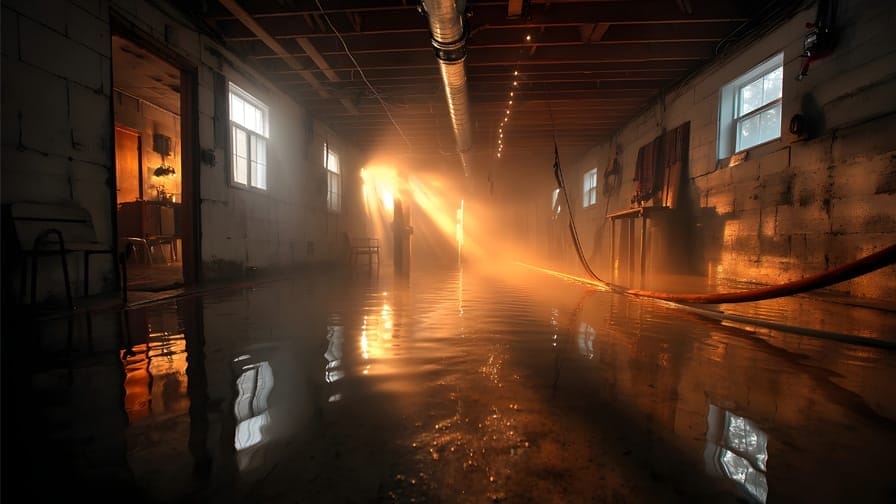
Cleaning Sewer Backup in Basement Areas
Basement cleanup is its own ordeal. Once a licensed plumber has cleared the line and stopped the flow, you can start dealing with the mess — but only with the right gear and the right approach.
Wear waterproof boots, heavy gloves, eye protection, and an N95 mask at minimum. Open windows and run fans to ventilate. Remove standing water with a wet/dry shop vac (never a regular household vacuum), and bag up anything porous that got soaked: cardboard boxes, drywall, carpet, padding, particleboard furniture, and most upholstered items. These materials trap bacteria and almost never come fully clean.
Hard surfaces — concrete, tile, sealed wood — can be scrubbed and disinfected with a strong cleaner, then a bleach solution (one cup of bleach per gallon of water). Let everything dry completely before bringing items back into the space.
If the backup covered more than a small area, or if it soaked into walls or subflooring, this is the point where most homeowners call in a sewer backup restoration company. They have industrial dehumidifiers, antimicrobial treatments, and the ability to document everything for your insurance claim. Speaking of which: photograph everything before you throw it out. Your homeowner’s policy may cover the loss, especially if you have a sewer backup rider.
Health Risks: Why Sewage Exposure Is More Dangerous Than It Looks
Sewer backup water isn’t just dirty — it’s classified as Category 3 “black water” by water damage professionals, meaning it carries pathogens that can cause real illness. Raw sewage contains E. coli, salmonella, hepatitis A, rotavirus, giardia, and a long list of other bacteria, viruses, and parasites. Even brief skin contact, especially through a cut or scrape, can lead to infection. Inhaling the aerosolized droplets and gases (hydrogen sulfide, methane, ammonia) can trigger headaches, nausea, and respiratory problems — and in poorly ventilated basements, sewer gas can reach concentrations that are genuinely hazardous.
The risks don’t end when the water is gone. Mold can begin growing on damp materials within 24 to 48 hours, and contaminated drywall or carpet padding can off-gas for weeks. Children, elderly family members, pregnant women, and anyone with a compromised immune system should stay out of the affected area entirely until cleanup and disinfection are complete.
If anyone in the household develops a fever, stomach symptoms, a skin infection, or a persistent cough in the days following a backup, see a doctor and mention the exposure. New Jersey’s humid summers and damp basements make mold a particularly fast-moving problem here, which is one more reason not to let cleanup drag.
Why Sewer Backups Happen So Often in New Jersey
A few things make NJ homes especially vulnerable, and it’s worth understanding the local picture:
Aging infrastructure. Much of New Jersey’s housing stock was built between the 1920s and 1970s, which means a lot of sewer laterals are clay, cast iron, or Orangeburg (a tar-paper pipe used heavily in post-WWII construction that’s notorious for collapsing). Many municipal sewer mains are equally old. When the city’s main is overwhelmed or partially blocked, your home becomes the relief valve.
Mature trees. The leafy, established neighborhoods that make towns like Basking Ridge, Middlesex, and South Plainfield so attractive also have decades-old root systems that have been quietly working their way into sewer joints for years.
Climate and storms. New Jersey has been seeing heavier and more frequent rain events over the last decade. Combined sewer systems in older parts of the state can’t keep up during downpours, which is when flood-driven backups spike. Basements in low-lying areas of Middlesex County are especially prone.
Local regulations and rebates. Some NJ towns and sewer authorities offer rebates or partial reimbursement for backwater valve installation, particularly in areas with a history of municipal backup issues. Check with your local public works department or sewer utility — it’s worth a phone call before you pay out of pocket. New Jersey also requires that any work on your sewer lateral be performed by a licensed master plumber, and permits are typically required for line repair or replacement.
When Sewer Backups Happen The Most in New Jersey
Sewer backup calls aren’t evenly distributed across the year — there are clear patterns, and knowing them can help you stay ahead of trouble:
Spring (March–May) – This is peak season for backups in NJ. Frozen ground thaws, soil shifts, and any hairline cracks in older clay or Orangeburg laterals widen as the earth moves. Combine that with heavy spring rains and tree roots actively growing toward moisture, and you have the perfect conditions for a backup. Spring is also when municipal sewer mains get overwhelmed most often.
Late summer and early fall (August–October) – Tropical storm and hurricane remnants sweeping up the East Coast routinely dump several inches of rain on New Jersey in a few hours. Combined sewer systems in older parts of the state can’t keep up, and basements in low-lying areas — especially in Middlesex County and along the Raritan River corridor — see a wave of flood-driven backups every September.
Around the holidays (Thanksgiving through New Year’s) – Plumbers everywhere see a spike in kitchen-line and main-line clogs the week of Thanksgiving and the week of Christmas. The cause is almost always the same: cooking grease poured down the drain, food scraps from big meals, and houseguests doubling normal water use. If you’re hosting, get your line cleaned in early November.
Winter cold snaps – Hard freezes can crack already-compromised pipes, and frozen sections of pipe can trap waste and create blockages that surface as soon as things thaw.
If you’ve had a backup before — or your home has any of the risk factors mentioned earlier (mature trees, clay/Orangeburg pipes, finished basement, low-lying lot) — schedule preventive cleaning before the spring thaw and again before holiday hosting season.
What Not to Do During a Sewer Backup
Most of the worst damage we see comes from well-intentioned mistakes in the first hour. Avoid these:
- Don’t pour bleach, drain cleaner, or chemical “openers” down the drain to try to clear it. Chemical drain cleaners do nothing for a main-line clog and create a serious hazard for the plumber who has to work on the line afterward — they can splash back during snaking and cause chemical burns.
- Don’t use a regular household vacuum on standing water. It will destroy the vacuum and can cause electrical shock. Use a wet/dry shop vac only, and only if power to the area is off.
- Don’t try to plunge a main-line backup. Plunging an individual fixture is fine for a local clog, but plunging when the main line is blocked just forces sewage into other fixtures or up through floor drains.
- Don’t run a snake or auger you bought at a hardware store down the main line. Consumer-grade augers can break off inside the pipe, get tangled in roots, or push the clog further down where it’s harder to reach.
- Don’t ignore early warning signs. Multiple slow drains, gurgling toilets, or a sewer smell in the basement are not “wait and see” symptoms — they’re a partial blockage announcing itself before it becomes a full backup.
- Don’t throw out damaged belongings before photographing them. Insurance adjusters need documentation, and items in the trash can’t be claimed.
- Don’t enter the affected area without protective gear. No bare feet, no shorts, no skipping the mask. Sewage exposure causes real illness.
- Don’t try to handle a major cleanup alone. Anything bigger than a small contained spill on a hard surface needs professional restoration — both for safety and for proper insurance documentation.
Renting vs. Owning: Who Handles What?
If you’re renting and a sewer backup happens in your unit, the steps are a little different — and getting them right protects you legally and financially:
Call your landlord or property manager first, before calling a plumber. In New Jersey, the landlord is responsible for maintaining the plumbing system and for repairs to the sewer line. Calling a plumber on your own without authorization can leave you stuck with the bill, and most leases explicitly require the landlord to arrange repairs.
Document everything anyway. Take photos and videos of the water level, damaged belongings, and any affected areas — even if the landlord is handling the repair. You’ll need this if there’s any dispute about damaged personal property later.
Move yourself, family, and pets out of the affected area. Your landlord’s responsibility doesn’t extend to your personal safety in the moment. If the backup is severe and the unit isn’t habitable, you may have rights under NJ tenant law to demand alternative accommodation or rent abatement until repairs are complete.
Renter’s insurance is what covers your stuff. The landlord’s policy covers the building. Your personal belongings — furniture, electronics, clothing, anything that gets ruined — are only covered if you have your own renter’s insurance, and in many cases only if your policy includes a sewer backup endorsement (same as homeowners). If you don’t have it yet, get it before you need it; renter’s insurance with backup coverage typically costs $15–25 a month in NJ.
Keep written records of everything. Texts, emails, repair receipts, dates the landlord was notified, dates work was performed. If the landlord delays repairs and the damage gets worse, that paper trail matters.
Owners, on the other hand, carry both responsibilities — fixing the line and handling the cleanup — and bear the full insurance and legal exposure discussed above. If you own a multi-unit property or rent out a basement apartment, a backup that affects a tenant brings habitability obligations and potential rent abatement into play, on top of the repair itself. Address it fast.
How to Prevent the Next Sewer Backup
Once you’ve been through one sewer backup, you do not want a sequel. A few things make a real difference:
- Get your main line cleaned before there’s a problem. Most homes benefit from professional drain cleaning every 18 to 24 months, sooner if you have mature trees in the yard.
- Install a backwater valve. This one-way valve sits on your main sewer line and prevents municipal sewage from flowing backward into your home during heavy storms. Some towns even offer rebates for installation.
- Be careful what you flush. The only things that should go down a toilet are human waste and toilet paper. Wipes — even the “flushable” kind — paper towels, feminine products, and dental floss all cause clogs.
- Never pour grease down the drain. Let it cool and throw it in the trash.
- Watch for early warning signs. Slow drains in multiple fixtures, gurgling toilets, water backing up in the tub when you run the washing machine, or a soggy patch in the yard over your sewer line all suggest a partial clog that’s going to become a full one.
What to Do When a Sewer Backup Happens During a Major Storm
A sewer backup during a hurricane, tropical storm remnant, or major nor’easter is a different situation from a backup caused by tree roots or a clogged line. The 60-minute checklist above still applies, but several storm-specific complications change what’s possible, what’s safe, and what should wait.
Emergency Plumbers Are Stretched Thin
During a major storm event, every plumber in your area is fielding emergencies simultaneously. Response times that would normally be 30 to 90 minutes can stretch into hours or days, particularly during widespread flooding events like Hurricane Ida or Henri. This means triage matters more than usual.
If you can reach an emergency plumber, do so immediately — but be realistic about response time. While you’re waiting, focus on stopping water use, getting people and pets out of the affected area, killing power to the affected area at the breaker, and documenting the damage with photos and video. Don’t waste hours waiting for a plumber to arrive before taking these immediate-safety steps.
If you can’t reach a plumber at all, the situation is genuinely temporary in most cases. Flood-driven backups typically resolve as floodwaters recede and the municipal system catches up — usually hours after the rain stops, sometimes a day or two for the worst events. Your job during that interval is to limit damage and protect health, not to fix the line.
Power Considerations Are More Complicated
Major storms knock out power, which compounds the situation in several ways:
Standing water and live electrical sources are more dangerous when you can’t see clearly. Flashlights help, but in a darkened basement with debris floating in standing water, the risk of stepping on a partially submerged extension cord or coming into contact with an energized outlet is real. If the power is on and water has reached anywhere near outlets, appliances, or extension cords, do not enter the area until the breaker is off.
Generator backfeed is a real hazard. If you’re running a portable generator, it should be connected only to specific appliances directly, never to a wall outlet. Backfeeding power into your home’s wiring can energize fixtures and outlets in the flooded area even when the main breaker is off.
Sump pumps are likely already failed. A flood-driven sewer backup almost always coincides with extended power outages. The primary sump pump is probably dead, and if you have a battery backup, it may be discharging fast. This is the moment to confirm what’s running and what isn’t, because in a worst-case scenario you’re managing groundwater intrusion through the foundation and sewer water through the floor drain at the same time.
For an explanation of why municipal sewers can’t keep up during major storms and how groundwater intrusion compounds the basement water problem, see our guide to sump pumps and basement water management in NJ.
Two Sources of Water at Once
During Hurricane Ida and Hurricane Henri, homeowners across Central and Northern New Jersey reported finding water entering their basements from two directions simultaneously: groundwater seeping or pouring through foundation walls, and sewer water rising up through floor drains and basement fixtures. The two problems look similar in the moment. A wet basement is a wet basement — but they’re different failure modes with different responses.
Sewer water carries pathogens that groundwater doesn’t. If you have any way to identify which source is producing what, treat all standing water as contaminated until confirmed otherwise. The visible signs are usually clear: sewer backup typically smells distinctly of sewage and may contain visible solids or toilet paper, while groundwater is generally cleaner-looking and odor-free. When in doubt, assume contamination and don’t enter without protective gear.
Backwater Valves: The Only Real Defense Against Flood-Driven Sewer Backups
If your home is in a part of New Jersey prone to flood-driven backups — anywhere with a basement bathroom, basement floor drain, or laundry standpipe in a neighborhood that’s seen sewer backups during major storms — a sewer backwater valve is the single piece of equipment that prevents the problem. Sump pumps don’t. Drain cleaning doesn’t. Backwater valves do, and they’re the only mechanical solution that addresses the failure mode where municipal sewer pressure reverses and pushes wastewater back through your lateral.
A sump pump and a backwater valve solve different problems, and a complete flood-resilience setup typically includes both — see our sump pump guide for the groundwater side of basement water management.
How a Backwater Valve Works
A backwater valve sits on your main sewer lateral, usually installed near the foundation exit point in the basement. Under normal conditions, wastewater flows out of the house through the valve toward the municipal main with no resistance. When pressure in the municipal sewer reverses during a flood event and tries to push water back toward your home, the valve closes automatically — sealing the line and preventing the backflow until municipal pressure normalizes.
The valve does its job mechanically. No power required, no homeowner intervention during the event, no monitoring needed during the storm itself. That’s the entire point: when the power is out and you can’t get a plumber on the phone because every plumber in the county is buried, the backwater valve has already done what it was installed to do.
Types of Backwater Valves
Not all backwater valves are the same, and the right choice depends on your home’s plumbing layout:
- Gate valves (manual). A manually operated gate that the homeowner closes when a backup is anticipated. Less common in modern installations because they require active homeowner attention and only work if the homeowner is home, awake, and aware that a flood event is coming.
- Flap-style check valves (automatic, “normally open”). A hinged flap that hangs open under normal flow conditions and snaps shut when reverse pressure pushes it closed. The most common modern installation. Reliable when properly maintained, allows full normal sewer flow without restriction.
- Combination valves with manual override. An automatic flap valve combined with a manual gate, giving the homeowner the option to physically secure the line during anticipated major events. Higher cost but more peace of mind in flood-prone areas.
- Normally closed valves. Less common in residential applications. The valve is closed by default and opens only when household wastewater pushes through. Used in specialized situations.
For most New Jersey homes, an automatic flap-style check valve is the right answer.
Installation Cost in New Jersey
Backwater valve installation costs in New Jersey vary based on several factors:
- Whether the home has an existing accessible cleanout. Installation is significantly cheaper when the valve can be installed at an existing cleanout location.
- Whether excavation is required. If the lateral isn’t accessible inside the basement, installation may require breaking through the basement floor or excavating outside to reach the line.
- Pipe material and condition. Older laterals (clay, cast iron, Orangeburg) sometimes need partial replacement to accommodate the valve.
- Permit and inspection requirements. New Jersey requires backwater valve installation to be performed by a licensed master plumber, and most municipalities require a permit and inspection.
A professional assessment provides an accurate estimate. Replacement of an existing valve is typically less expensive than a first-time installation that requires excavation or basement floor work.
Municipal Rebate Programs in New Jersey
Some New Jersey towns and sewer authorities offer rebates or partial reimbursement for backwater valve installation, particularly in areas with documented histories of municipal backup issues. Programs vary year to year and by jurisdiction — check with your local public works department, sewer utility, or municipal building department before paying out of pocket. A 15-minute phone call has saved homeowners several hundred dollars in some cases.
If your municipality has had multiple flood events with widespread basement backups, ask specifically whether a homeowner rebate or buyback program is currently active. These programs often expand after major storm events and contract during quieter years.
Maintenance Requirements
A backwater valve is mechanical, which means it can fail mechanically — and a failed backwater valve is worse than no valve at all because the homeowner believes they’re protected when they’re not.
Annual inspection is essential. The valve should be opened, visually inspected for debris, sediment, or grease buildup that could hold the flap open or prevent it from sealing, and tested for proper operation. The hinge mechanism should move freely. Any wear on the seal surface should be addressed before the next storm season.
In high-use households or homes with older sewer laterals that produce significant sediment, more frequent inspection (twice a year) is reasonable. The cost of an inspection visit is far less than the cost of discovering a failed valve during a hurricane.
Permit and Code Requirements
Backwater valve installation in New Jersey is regulated. The work must be performed by a licensed master plumber, a permit is typically required from the local building or plumbing department, and the installation must pass inspection before being put into service. Some municipalities require backwater valves on new construction in flood-prone zones; others recommend but don’t mandate them. A licensed plumber can confirm the specific requirements for your township and walk you through the permit process.
Skipping the permit creates two problems: an unpermitted installation may not be eligible for municipal rebate programs, and an unpermitted modification to your sewer lateral can complicate insurance claims if a backup happens despite the valve.
Is a Backwater Valve Worth It?
For homes in flood-prone areas of New Jersey, the answer is almost always yes. The cost of installation is a fraction of the cost of a single basement sewer backup cleanup — and that’s before factoring in the property damage, lost belongings, mold remediation, health risks, and insurance complications. The valve protects against a specific failure mode (municipal sewer pressure reversal during heavy storms) that no other piece of equipment addresses. For homes with finished basements, basement bathrooms, or laundry rooms below grade, the calculation is even more obvious.
Homes that aren’t in flood-prone areas, with high basements above the municipal main or no below-grade fixtures, may not need one. A licensed plumber can evaluate your specific home’s exposure and recommend whether installation is justified.
Need A Sewer Backup Valve?
Contact us today
call us at (908) 472-3801 or request and estimate below on a sewer backup valve installation today.
Request An EstimateFrequently Asked Questions About Sewer Backups
Is a sewer backup an emergency?
Yes. Once raw sewage is inside your home, every hour adds to the damage and the contamination footprint. Mold can start within 24 to 48 hours, porous materials absorb bacteria quickly, and the longer water sits, the more subfloor and drywall you’ll lose. Call a 24/7 emergency plumber as soon as you notice it.
Who is responsible for a sewer backup — the homeowner or the city?
It depends on where the blockage is. The portion of the sewer line from your house to the connection at the municipal main — called the lateral — is almost always the homeowner’s responsibility in New Jersey. If the blockage is in the city’s main line and sewage backs up into your home as a result, the municipality may share responsibility, though getting reimbursed is rarely simple. A camera inspection helps establish where the problem started.
Will homeowner’s insurance pay for a sewer backup?
Only if you have a sewer backup endorsement (water backup rider) on your policy. Standard homeowner’s insurance excludes sewer and drain backups by default. Flood insurance is a separate product and generally doesn’t cover backups either unless they’re caused by a covered flood event. Call your agent now if you’re not sure what you have — most riders cost less than $200 a year.
Can I clean up a sewer backup myself?
A small, contained backup on hard surfaces (tile, sealed concrete) can sometimes be handled by a homeowner with proper PPE — waterproof boots, heavy gloves, eye protection, and an N95 respirator. Anything larger, anything that touched porous materials like drywall or carpet, or anything in a finished basement should go to a professional restoration company. The biohazard risk and the insurance documentation alone usually make pros worth it.
How do I know if it’s a sewer line problem or just a clogged drain?
The clearest sign is multiple fixtures backing up at once. If you flush a toilet and water comes up in the tub, or running the washing machine causes the basement floor drain to gurgle, the problem is in your main sewer line, not an individual fixture. A single slow drain is usually a local clog. Backups in multiple fixtures point to the main line.
How often should I have my sewer line cleaned to prevent backups?
For most NJ homes, every 18 to 24 months is a reasonable interval. If you have mature trees in your yard, an older home with clay or Orangeburg pipes, or a history of slow drains, every 12 months is smarter. Preventive hydro-jetting costs a fraction of an emergency call — and a tiny fraction of what you’ll spend on water damage cleanup if a backup catches you off guard.
Will my sewer back up during a hurricane?
It depends on your municipality’s sewer system, your home’s elevation, and the severity of the storm. Homes in older NJ communities with combined storm-and-sanitary sewer systems are at significantly higher risk, as are homes with basement fixtures (bathrooms, floor drains, laundry standpipes) that sit below the level of the municipal main. Hurricane events that produce six or more inches of rain in 24 hours — like Hurricane Ida — overwhelm essentially every municipal sewer system in their path, and basement backups become widespread regardless of individual property risk factors. The only mechanical defense is a backwater valve installed on the sewer lateral. If you’ve experienced a flood-driven backup before, or if your home has the risk factors above, a backwater valve is the single most cost-effective protection you can add.
When to Call a Pro
Some clogs really are a plunger-and-a-bottle-of-drain-cleaner job. A sewer backup is not one of them. If you’re seeing wastewater coming up through fixtures, multiple drains running slow at once, or any sewage smell in the basement, you need professional equipment — a sewer inspection to find the actual problem and a hydro-jetter or auger to clear it.
Get in Touch
Contact us today
Our team is available around the clock to clear blockages, camera-inspect your line to find the root cause and get your home back to normal as quickly as possible. If you’re dealing with a backup right now — or you want to schedule preventive cleaning before one happens.
Reach us at (908) 472-3801.
Request An estimate