Root intrusion is the most common pipe-side failure mode we see on residential sewer lines in central New Jersey. It’s also one of the most misunderstood. Roots don’t break healthy pipe — they exploit pipe that’s already compromised. Once you understand that, the whole conversation about diagnosis and repair changes.
This guide walks through how root intrusion happens in NJ sewer lines, why mature-tree neighborhoods see it more than newer ones, the warning signs at the property, how a camera confirms it, and which repair methods actually solve the problem versus which ones just delay the next failure.
Arrow Sewer & Drain provides sewer evaluation, hydro jetting, trenchless repair, and excavation across New Jersey, with primary service in Middlesex, Somerset, Union, Monmouth, and Hunterdon counties.
In This Guide
- What Root Intrusion Actually Is
- How Roots Get Into Sewer Pipes
- Why It’s So Common in New Jersey
- Warning Signs at the Property
- How Root Intrusion Causes Basement Sewer Backups
- Confirming Root Intrusion With a Camera Inspection
- How to Remove Roots From a Sewer Line
- When the Pipe Itself Needs Repair or Replacement
- What Doesn’t Work (and Why)
- Frequently Asked Questions
- Where to Go From Here
What Root Intrusion Actually Is
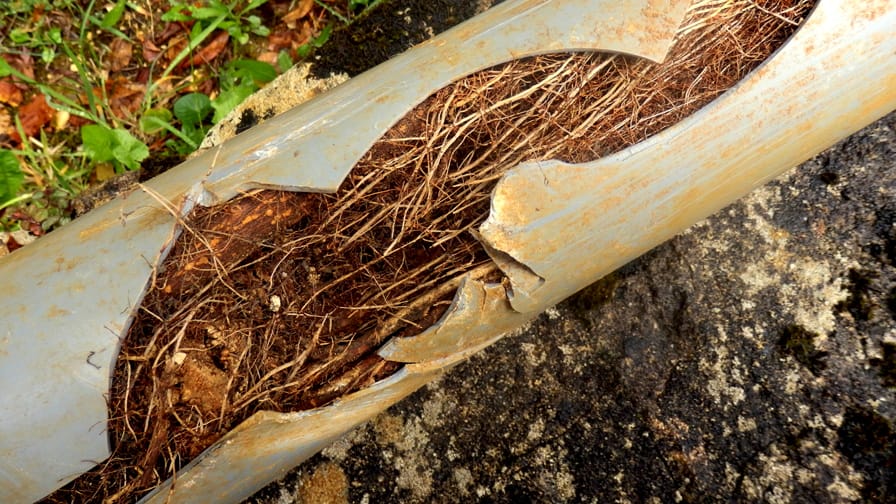
Root intrusion is what happens when tree or shrub roots grow into the inside of a buried sewer line. Once inside, they expand, branch, and trap solids until the line slows, smells, or backs up entirely.
The detail most homeowners get wrong is the order of events. Roots don’t drill through sound pipe. A healthy, sealed sewer line is a closed system — there’s no moisture leaving it for roots to find. What roots find is a pipe that’s already leaking somewhere: a hairline crack, a separated joint, a deteriorated section of Orangeburg, a corrosion pit in old cast iron, or a connection where the gasket has failed. The leak is the invitation. Roots show up because the pipe is already telling them where it is.
This matters because it changes what “fixing root intrusion” means. Cutting the roots out solves the symptom for a season or two. Sealing or replacing the part of the pipe the roots came through is what solves the problem. A repair that only removes roots, without addressing the breach they came through, sets the homeowner up for the same problem on the same timeline.
This is the pipe-failure side of the framework we cover in Why Sewer Lines Fail: It’s Usually Not the Pipe — root intrusion at joints is one of the classic residential pipe failures, and it’s almost always specifically a joint or crack failure rather than a general material failure.
How Roots Get Into Sewer Pipes
Roots grow toward what they need: water, oxygen, and nutrients. A sewer line, particularly an older one, leaks all three.
When pipe joints separate slightly, when a hairline crack opens in clay tile, when an Orangeburg section deforms, or when cast iron corrodes through, two things happen at the breach. The first is that wastewater, which is rich in nitrogen, phosphorus, and warmth, seeps out into the surrounding soil. The second is that pipe gases — water vapor and small amounts of oxygen — escape into the soil at the same point. To a tree root growing through that soil, the area immediately around that breach is a concentrated plume of moisture, nutrients, and air. Roots chase that plume.
Once a single fine root reaches the breach, it doesn’t just stop there. It grows through the gap and into the wet, warm interior of the pipe — which is an even better growing environment than the soil outside. Inside the pipe, the root branches into a fine, hair-like mat that catches passing solids. Toilet paper, grease, and waste accumulate in that mat. The root system uses those trapped solids as additional nutrients, which speeds up its growth. Over months and years, what started as a single fine root becomes a dense root ball — sometimes spanning multiple feet of pipe — that progressively blocks flow.
The breaches roots exploit, in roughly the order of frequency we see in NJ:
- Joints between clay tile sections. Pre-PVC clay sewer lines were laid in 2- to 4-foot sections joined with mortar or hot-poured bitumen. Decades of soil movement and freeze-thaw cycles loosen those joints, even when the clay itself is intact. The joint is the weak point, and roots find it.
- Deteriorated Orangeburg. This tar-impregnated wood-fiber pipe was used heavily in NJ residential construction from the late 1940s through the early 1970s. It softens, deforms, and delaminates predictably. By the time it’s 50 years old, it has failed in multiple places, and roots have been working through it for a decade or more.
- Cracked cast iron. Cast iron lines from the same era corrode from the inside out. As the wall thins, hairline fractures open. They’re small enough that a homeowner sees no immediate symptom — but they leak enough moisture into the surrounding soil to attract roots.
- Connection points. Where the home’s lateral connects to the city main, where a branch line ties into the main lateral, or where a cleanout has been added — anywhere there’s a transition, there’s a higher chance of seal failure than along a continuous run of pipe.
- Pipe damaged by past disturbance. Lines that were nicked during a previous excavation, that settled into a low spot when bedding washed out, or that were impacted by a heavy load above are common starting points.
What roots don’t do, in NJ residential conditions: they don’t grow through intact PVC, they don’t penetrate sound modern pipe joints with proper rubber gaskets, and they don’t break sound cast iron pipe. New construction with properly bedded PVC and gasketed joints essentially doesn’t see root intrusion. Root intrusion is a problem of older pipe in older neighborhoods.
Why It’s So Common in New Jersey
The conditions that produce root intrusion stack up unusually well across New Jersey.
Pre-1972 housing stock. Roughly half of NJ housing predates 1972, including most established neighborhoods in Middlesex, Somerset, Union, Monmouth, and Hunterdon counties. The original sewer lines in those homes are typically clay tile, Orangeburg, or cast iron — three of the four highest-risk materials for root intrusion. Most are at or past the age where joint deterioration and material breakdown are well underway.
Mature tree canopy. Older NJ neighborhoods have decades of tree growth directly over the sewer line corridor. Maples, oaks, silver poplars, willows, and sweetgums are particularly aggressive root-seekers — silver maples and willows are notorious. The street trees in towns like Plainfield, Westfield, Cranford, Somerville, and similar pre-war communities have root systems that extend well beyond the canopy and reach the sewer line easily. The mature-tree-plus-old-pipe combination is one of the most common root causes of basement backups we see across central NJ.
Clay-heavy soils with seasonal moisture variation. Central NJ soils generally have moderate-to-high clay content. Clay shrinks and swells with seasonal moisture, which works pipe joints loose and opens hairline cracks over years. The same soil chemistry holds water against the pipe for long periods, giving roots a sustained moisture target.
Freezing depths in the active zone of the pipe. New Jersey frost depth runs 36 to 42 inches for most residential lines. Most older residential sewer pipes sit within or just below the frost zone, which means freeze-thaw cycles are working the pipe and its joints every winter. After 50 to 80 winters, joints that were tight when installed are no longer sealed.
The result. A typical pre-1972 home in a tree-lined NJ neighborhood combines aging high-risk pipe materials, an active root system overhead, soils that work pipe joints loose, and a freeze-thaw climate that accelerates joint separation. That’s why we’re rarely surprised when a camera inspection on a 70-year-old home in Cranford or Westfield comes back showing root intrusion. We’d be more surprised if it didn’t.
From Luis Fanlo, owner: In fifteen-plus years of camera inspections across central NJ, root intrusion is on the short list of things I expect to see on any pre-1972 home with mature trees out front. The question isn’t usually whether there’s root intrusion — it’s how far along it is, what pipe it’s growing into, and what’s the right repair given both. People hear “root intrusion” and think the trees are the problem. The trees are doing what trees do. The problem is the pipe.
Warning Signs at the Property
Roots grow inside the pipe slowly. By the time symptoms reach the house, the intrusion has typically been progressing for months or years. The earlier you catch it, the more options you have.
Slow drains and recurring backups. A single slow drain is a fixture problem. Multiple slow drains across the house or drains that back up when you run laundry or take a long shower, point to something restricting the main line. Roots are one of the more common reasons for that.
Gurgling from toilets and floor drains. When the line is partially blocked, water draining from upstream fixtures forces air past the obstruction, which produces a gurgle at the next downstream fixture. Toilets gurgling when the washing machine drains, or a basement floor drain bubbling when an upstairs sink runs, both point to a partial main-line obstruction.
Foul sewage smells in or around the home. A persistent sewage smell that doesn’t go away with cleaning — particularly if it’s worst near floor drains, around the foundation, or in a specific area of the yard — indicates the pipe is leaking somewhere. That leak is what attracted roots in the first place.
Wet, soggy, or unusually green patches in the yard. When wastewater leaks into the soil around the pipe, it acts like a natural fertilizer. The grass directly above the leak typically grows faster, greener, and lusher than the surrounding lawn. In dry summer stretches, you’ll often see a stripe of green grass that traces the path of the sewer line from the house out toward the street.
Increased insect or rodent activity. Sewer leaks attract pests. A sudden uptick in flies, ants, or rodents around a particular section of the foundation or yard — particularly along the line route — can be a leak signal.
Pavement cracking, sinking, or settling along the line. Less common at the residential scale, but it does happen. When a leaking line washes soil out from around itself over time, the surface above can settle. A driveway, sidewalk, or patio that’s developing a crack or a low spot along the path of the sewer line is worth checking with a camera.
The patterns matter more than any one symptom. A single slow drain doesn’t mean root intrusion. A slow drain plus a green stripe in the yard plus an occasional gurgle from the basement floor drain — in a home built in 1955 with a 60-foot-tall maple at the curb — that’s a pattern, and it warrants an inspection.
Signs of a Failing Sewer Line: Sewer problems rarely announce themselves clearly — they show up as a mix of small symptoms that property owners often dismiss until the failure is well underway. For a deeper look at the warning signs that point to a leaking or failing sewer line, and what each one usually indicates, see our complete guide to signs of a leaking sewer line.
How Root Intrusion Causes Basement Sewer Backups
The most disruptive symptom of root intrusion is the one that brings most homeowners to the phone: water, and sometimes raw sewage, coming up through a basement floor drain, a basement toilet, or a laundry sink. Understanding the mechanism explains why it happens at the basement specifically and why it tends to happen at the worst possible times.
A residential sewer line runs by gravity from the house out to the city main. Every drain in the house — kitchen, bathrooms upstairs, laundry, basement fixtures — empties into that single line. The basement fixtures are the lowest point in the system. They’re also typically connected closest to where the line leaves the house, which means they sit just upstream of any blockage in the main lateral.
When a root mass partially blocks the line, water from upstream fixtures still flows past the blockage — slowly. If the household isn’t using much water, the line keeps up and nothing seems wrong. The trouble starts when water volume exceeds what the partially blocked line can pass.
Common triggers:
- Running the washing machine, which dumps 20 to 40 gallons of water into the line in a few minutes
- Multiple showers in a row, especially in the morning
- A dishwasher running while the laundry is going
- Heavy rain, if the home has any stormwater connection to the sanitary line (older NJ homes sometimes do, even when they shouldn’t)
- A toilet flushing while other fixtures are draining
When upstream volume exceeds the blockage’s flow capacity, water starts backing up in the line. It rises until it finds the lowest open exit — which is whichever basement fixture sits below the blockage. That’s the basement floor drain, the basement toilet, or the laundry standpipe. Water pours out of the lowest point because that’s where physics sends it. Upstairs fixtures don’t back up because their drain openings are above the level the water is rising to.
This is why a basement backup is rarely a sign that something is wrong with the basement. The basement fixture is the messenger, not the cause. The blockage is somewhere in the main line, often near the house but sometimes well out toward the street. We cover the immediate response steps — what to shut off, what not to touch, and when to call — in our sewer backup guide.
There’s a second, more severe pattern worth flagging. If a root mass progresses from partial blockage to near-total blockage, even ordinary household water use will trigger a backup. At that point homeowners often see backups every time the washer runs, every time someone takes a long shower, sometimes daily. This is the stage where a “we’ll keep an eye on it” line is no longer something to keep an eye on. It’s a line that needs immediate intervention before the next backup becomes a major flood.
Confirming Root Intrusion With a Camera Inspection
Symptoms make you suspicious. A camera confirms it.
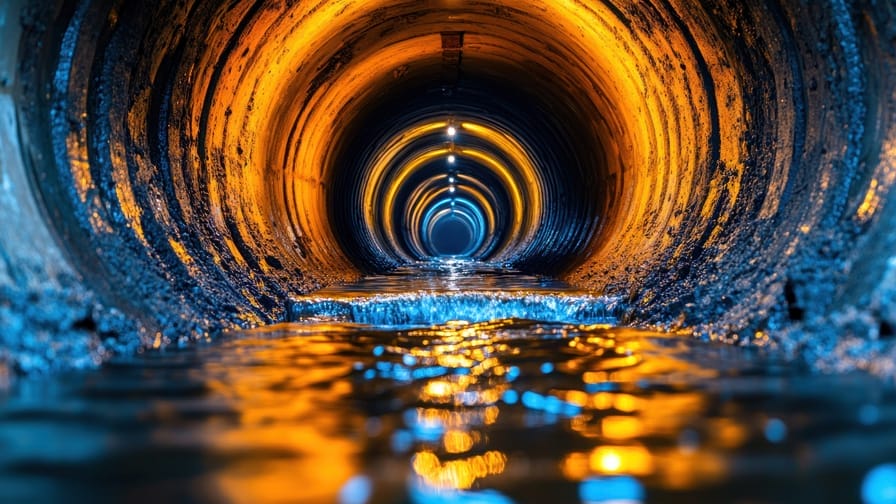
A sewer scope inspection runs a waterproof camera on a flexible push rod from a cleanout (or a pulled toilet) through the building’s drain into the main lateral, all the way to the street main. The camera shows what’s inside the pipe — and roots are unmistakable on camera. They appear as fine white or tan filaments hanging from joints, mats of hair-like growth filling part of the pipe diameter, or full root balls blocking flow. The camera also tells the inspector several things that the roots themselves can’t:
- The pipe material at the affected section — clay, Orangeburg, cast iron, or PVC. This determines what repair methods are appropriate.
- The exact location and distance from the cleanout — modern push cameras include footage counters and locator transmitters, so the precise point of intrusion can be marked at the surface.
- Whether the intrusion is at a joint or through cracked pipe wall — joints are typically a smaller fix than cracked sections.
- Whether there’s slope drift, sagging, or pooling at the affected area — soil-side problems often accompany pipe-side problems on older lines.
- Whether other defects are present along the run — finding roots at one joint doesn’t mean the rest of the line is sound. Frequently it isn’t.
We cover what a camera shows, and what good footage from an inspection should include, in our sewer inspection guide. The short version: a real diagnostic-grade inspection produces footage you can review, with distance markers and notes on each defect. A repair quote that doesn’t reference specific findings from a camera inspection — distance, pipe material, defect type, severity — is a guess.
For homeowners specifically, the sewer scope inspection is the standard tool. For larger commercial properties or HOAs evaluating private mains, CCTV inspection is the right level of equipment.
How to Remove Roots From a Sewer Line
Once a camera confirms root intrusion, the immediate goal is to clear the line. There are a few methods. They’re not equivalent.
Mechanical cutting (rooter / cable machine). A cable with a cutting head is fed through the line and the head spins to chop the roots. This is the cheapest and fastest method, and it’s what most plumbers default to. It works in the sense that it restores flow. It doesn’t work in the sense that it doesn’t remove the root mass — it just cuts the roots flush with the pipe wall and leaves the root system in the soil intact. The roots regrow. Most NJ homes that rely on annual cabling are on a 12- to 18-month re-rooting cycle.
Hydro jetting. A high-pressure water jet — typically 3,500 to 4,000 PSI for residential lines — is fed through the line on a hose with a specialized nozzle. The jets cut through the root mass, scour the pipe walls, and flush the debris out through the cleanout. Hydro jetting does several things mechanical cabling doesn’t: it removes the full root mass rather than cutting it flush, it cleans grease and scale buildup off the pipe walls (which is part of why roots took hold in the first place), and it leaves the pipe interior in a condition where a follow-up camera inspection can actually see the underlying defect. Hydro jetting is what we use as the standard-of-care for confirmed root intrusion on a structurally sound pipe — and it’s also the right preparation for a trenchless lining repair if that’s the next step.
The realistic sequence on a typical NJ residential line with confirmed root intrusion is: camera inspection to confirm and locate the intrusion → hydro jetting to clear the line completely → second camera inspection to assess what’s underneath → decision on whether the breach itself needs repair.
That second camera inspection is the part most quick-service plumbers skip. It’s also the most important step. The roots are the symptom. The breach is the actual problem. You can’t see the breach until the line is clean.
When the Pipe Itself Needs Repair or Replacement
Once the line is clean, the next decision depends on what the camera shows under the roots.
If the pipe is structurally sound with isolated joint separation: The breach can sometimes be sealed in place with trenchless spot repair methods. For minor joint intrusion in otherwise sound pipe, regular hydro jetting plus follow-up root treatment can keep the line functioning for years. If the joint has separated significantly, more durable solutions include trenchless cured-in-place pipe lining (CIPP) — a resin-saturated liner cured inside the existing pipe to form a new, seamless interior surface. CIPP eliminates the joints entirely along the lined section, which means no more root entry points along that run.
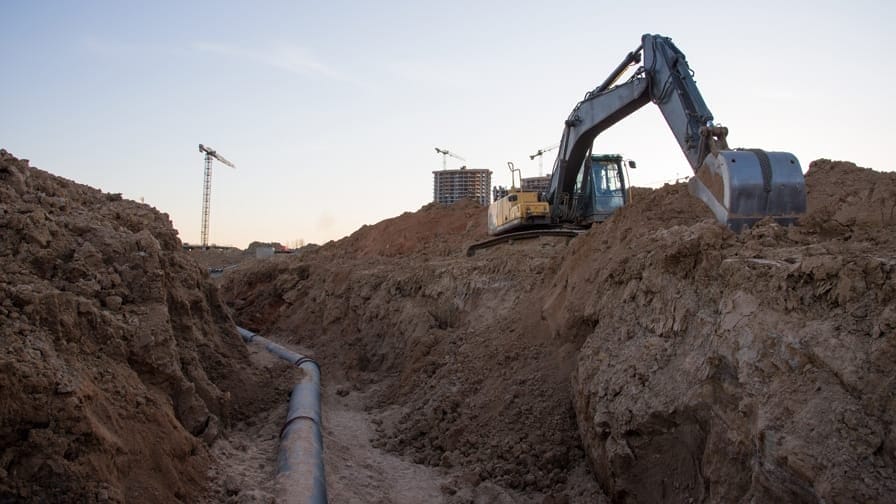
If the pipe is materially compromised: When the camera shows multiple breaches, deteriorated Orangeburg, cracked clay tile across multiple sections, or significant cast iron wall loss — the right answer is replacement, not patching. The two paths are traditional sewer repair by excavation, or trenchless replacement via pipe bursting, which pulls a new HDPE pipe through the path of the old one while breaking the old pipe outward into the surrounding soil.
Which one is right depends on the soil around the pipe, not just the pipe itself. If the pipe failed because of soil-side conditions — slope drift, bedding washout, gaps around the pipe — trenchless methods don’t fix the underlying problem and the new pipe will fail again on a similar timeline. If the soil is sound and the failure is purely pipe-side, trenchless is often the better answer because it’s faster, less disruptive, and doesn’t require digging up landscaping or a driveway.
For a full walkthrough of which trenchless method matches which kind of pipe failure, see our guide to choosing a trenchless method. The short answer for root-intrusion repairs specifically: CIPP lining is the most common appropriate choice when the pipe is mostly sound but has joint problems, and pipe bursting is the right answer when the pipe material itself has failed.
What Doesn’t Work (and Why)
A few things are widely recommended online and largely don’t solve root intrusion in any durable way.
Vinegar and baking soda mixtures. This shows up in DIY guides because it’s cheap and non-toxic. It also doesn’t work. Vinegar is too dilute to kill mature root mass, doesn’t repair the breach, and doesn’t clear an established blockage. The roots are unaffected.
Hand-cutting roots through a cleanout with manual augers. This is the homeowner version of mechanical cabling, with all the same limitations and a much higher chance of damaging an already-fragile pipe. The cutting head can hang up on a deteriorated section of Orangeburg or a cracked clay joint and turn a moderate intrusion into an immediate emergency. We don’t recommend it.
Cabling alone, repeated annually, on a pipe that has structural problems. Annual cabling is a reasonable maintenance approach for a small intrusion in a structurally sound line. It’s a treadmill on a line that’s deteriorating. If a homeowner is paying for cabling every 12 to 18 months on the same line, the question isn’t whether to keep cabling — it’s whether the underlying pipe needs repair or replacement.
Removing the tree. This is a question we get often. Removing the offending tree generally won’t help. Tree roots persist in the soil for years after the tree is removed, and a second tree several yards away will reach the same breach within a season or two if the breach isn’t repaired. Repair the pipe, and the tree is no longer a problem. Remove the tree without repairing the pipe, and you’ve spent thousands of dollars without solving anything.
Frequently Asked Questions
How do roots get into pipes if the pipe is buried?
Roots grow toward water and nutrients in the soil. A buried sewer line that’s developed any breach — a separated joint, a hairline crack, a deteriorated section — leaks small amounts of moisture and nutrients into the surrounding soil. Roots in the area detect that plume and grow toward it. Once a fine root reaches the breach, it grows through the gap into the pipe interior, where conditions for further growth are even better. It’s not that roots break sound pipe; they exploit pipe that’s already failed somewhere.
What dissolves tree roots in sewer lines?
This is a common search, and the honest answer is that no household or DIY treatment will dissolve an established root mass and repair the breach the roots came through. Various chemical products are sold for in-pipe root control, but they address the symptom rather than the cause — the roots are growing in because the pipe has a breach, and a chemical that kills the roots inside the pipe doesn’t seal the breach or address the soil-side root system that will regrow back through the same gap. The durable answer for confirmed root intrusion is hydro jetting to fully clear the line, followed by a second camera inspection to assess the pipe condition, followed by repair of the actual breach.
How do I know if I have root intrusion or a different kind of clog?
A camera inspection is the only reliable way to tell. Symptomatically, root intrusion tends to produce slow developing problems with multiple recurrences over months — recurring backups every few months, slow drains that come and go with weather and use, gurgling that gets worse over time. A grease clog or a foreign object tends to produce a sudden, total blockage with no history. A camera tells you definitively in about 30 minutes.
Can I fix root intrusion myself?
Realistically, no. Mechanical cabling can be rented but it’s risky on older pipe and doesn’t solve the problem. The cleaning, the inspection, and the assessment of what’s under the roots all require equipment and experience beyond what a typical DIY toolset includes. Once the line is clean and a camera has confirmed what’s underneath, the repair itself — sealing a joint, lining a section, or replacing pipe — is contractor work.
Will my insurance cover root intrusion repair?
Standard homeowners insurance typically does not cover sewer line repair from gradual causes like root intrusion or aging. Some policies offer optional service-line coverage as an endorsement, which may apply. Damage resulting from a sewer backup (basement flood damage, for instance) may be covered separately. Read your policy or call your carrier — but don’t assume coverage.
How long does root intrusion repair last?
It depends on what was repaired. Hydro jetting alone on a structurally compromised pipe typically lasts 12 to 18 months before regrowth becomes problematic. CIPP lining of an affected section eliminates the joints in that section and typically eliminates root intrusion along the lined run for the life of the liner — generally 50+ years. Pipe bursting replaces the pipe with seamless HDPE and similarly removes the joint problem. The durability of a repair is roughly proportional to how much of the underlying breach problem it addressed.
Should I replace the whole line if only part of it has roots?
Often, yes — particularly on pre-1972 homes. If roots have entered at one joint, the remaining joints in the same line are typically the same age, in the same soil, with the same exposure to root systems, and at similar stages of deterioration. A camera inspection along the full length of the line tells you definitively. If only one section is affected and the rest is sound, spot repair is reasonable. If the camera shows the rest of the line is also degraded, a partial repair is usually a stopgap.
Will the trees have to come down?
No. This is one of the most common worries we hear, and it’s almost never the right answer. Repairing the pipe so it no longer leaks removes the reason the roots came in the first place. The trees can stay, and so can the next generation of trees the homeowner plants on the same property.
Where to Go From Here
If you have signs of root intrusion — slow drains, recurring backups, sewer smells, or a green stripe across the lawn that follows your sewer line — the right next step is a camera inspection, not a repair quote.
If you already have a quote in hand, what to look for in a sewer line replacement quote walks through how to read it — whether the contractor referenced specific camera findings, whether the proposed method matches the actual failure mode, and what’s typically missing from quotes that come back too low. If something feels off after that read-through, a free second opinion costs nothing and frequently changes the recommendation.
Contact Arrow Sewer & Drain for sewer evaluation across central New Jersey — residential, commercial, and municipal.