Updated on 007/23/2026
A dry basement isn’t one fix — it’s seven layers working together, from the gutters down to the backwater valve. Below is everything this guide covers: how water moves from your roof to your foundation, which defenses stop it at each stage, how each layer fails, and which fixes to make first. Jump to the layer that’s causing you trouble, or read straight through to see how the whole system fits together — because the layer you ignore is the one the next storm finds.
A wet basement is rarely a basement problem. By the time water is on your floor, several other defenses have already failed — defenses that started at the roof, ran across the yard, and were supposed to keep water away from the foundation in the first place.
Defending against water intrusion isn’t one product or one fix. It’s a series of layers. Each layer catches what the layer before it missed. When the system works, you don’t notice it through any storm New Jersey can throw at you. When one layer is missing or undersized, the next layer takes the hit — and eventually the load lands somewhere that wasn’t designed for it.
This post walks through the layers in the order water moves: from the roof, across the yard, against the foundation, and finally into the basement when nothing upstream caught it.
Layer 1: Roof Drainage — Getting Water Off the House and Away From the Foundation
Every storm starts at your roof. A 2,000-square-foot roof in a 1-inch rain delivers roughly 1,250 gallons of water. In a 3-inch downpour — the kind New Jersey now sees several times a year from tropical storm remnants — that same roof produces close to 3,750 gallons in a few hours. That water is going somewhere. The job of your gutters and downspouts is to make sure it isn’t the foundation.
Where roof drainage usually fails. The most common failure point on NJ homes is the discharge end. A downspout that drops to a splash block 2 or 3 feet from the wall isn’t moving water away from the house — it’s depositing 1,250 gallons of water in a saturated ring of soil directly against the foundation. During a normal storm that’s manageable. During a major storm, that’s the source of the basement leak.
The fix is mechanical and inexpensive: longer downspout extensions (a minimum of 6 feet from the foundation, more if the lot allows), buried discharge lines that route water to daylight at a lower point on the property, or a tie-in to a dry well or yard drain system. Extensions are easy. Buried lines need to be pitched correctly, freeze-protected, and routinely cleared of leaves and silt — but they’re invisible and they work.
The illegal-tie-in problem. Some older NJ homes have downspouts connected directly to the sanitary sewer lateral. This was common decades ago and is now prohibited in most municipalities because it dumps stormwater into a system that was sized for wastewater only. During major storms, those tie-ins are part of why the municipal sewer overflows — and overflowing municipal sewers cause basement backups in everyone connected downstream. If your downspouts disappear into the ground and you don’t know where they go, it’s worth tracing.
Dry wells in NJ. A dry well captures roof discharge in a buried perforated chamber that lets water slowly infiltrate the surrounding soil. They work well in sandy soil. In the clay-heavy soils that dominate much of central New Jersey, dry wells need to be sized substantially larger than rule-of-thumb because infiltration is slow — and an undersized dry well in clay is just a buried bathtub that fills up and overflows back to where the water came from. They’re useful, but they have to be designed for the soil they’re going into.
Layer 2: Yard Drainage — Managing What Hits the Ground
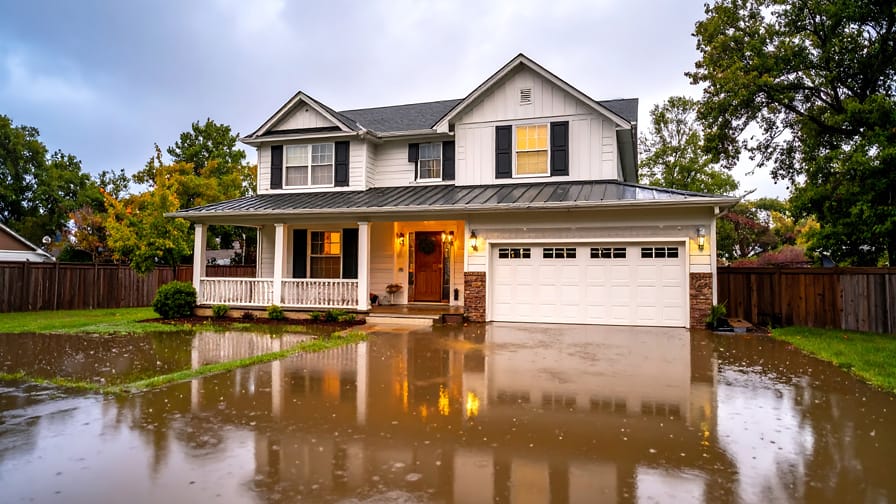
Once water is past the gutters — or never went through them — the yard’s job is to move it away from the house. The single most important factor here isn’t a product. It’s grading.
Grading is the foundation of foundation protection. The first 10 feet of soil around your foundation should slope downward at a minimum of 6 inches over that distance — roughly a 5% pitch. That sounds modest, but it’s the difference between water running away from the wall and water pooling against it. Most NJ homes had proper grading at construction. Forty or fifty years of settling, landscaping changes, mulch pile-up against the wall, and patio additions have changed it in ways that aren’t obvious from eye level.
If your grading is wrong, no other yard drainage solution can fully fix the problem. Regrading is the fix.
When grading isn’t enough. Some lots don’t allow proper foundation grading — the property is flat, the natural slope runs toward the house, hardscape blocks the runoff path, or a neighboring property is upslope and feeding water across the line. That’s where engineered yard drainage comes in:
- Yard drains and catch basins collect surface water at low points and route it through buried pipe to a discharge location.
- Channel drains (trench drains) are linear collection grates for driveways, patios, and walkways that intercept sheet flow.
- French drains are buried perforated pipe in gravel that captures subsurface water — useful when the problem is saturated soil rather than visible surface flow.
- Stormwater management systems combine these elements for larger lots or properties with significant runoff load. For commercial or multi-system installations, our stormwater management page covers the engineered side.
Common failure modes. A yard drain is only as good as its outlet. The most common failures we see:
- The outlet discharges to a spot that also floods during the storm, so the system has nowhere to send the water it collected.
- The outlet is buried under landscaping, clogged with leaves and silt, or has been pinched by tree roots.
- The line freezes in winter and holds water against the foundation through the spring thaw.
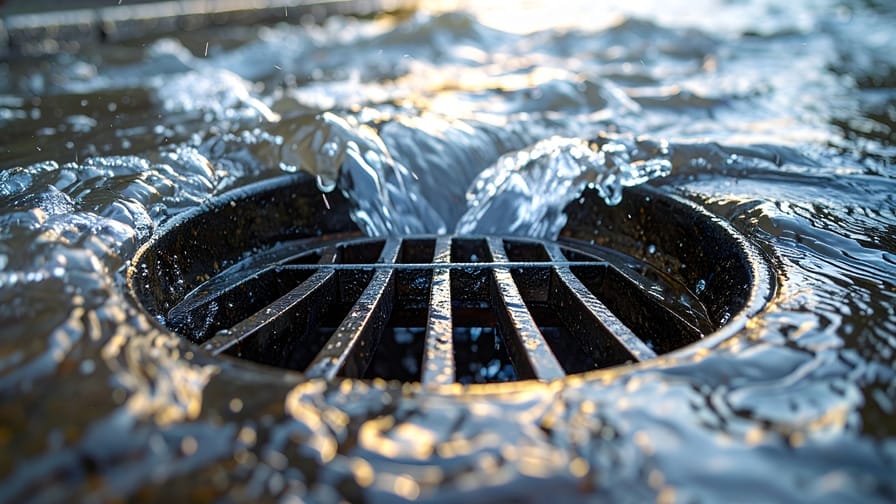
- The catch basin grate is clogged, so surface water flows past the inlet entirely.
A yard drain that’s backing up toward the house is worse than no yard drain at all. Every collection point needs an outlet that’s lower than the inlet, every outlet needs to discharge somewhere the water can leave the property, and the whole path needs to be inspectable.
Layer 3: Standing Water — When the Yard Itself Is the Problem
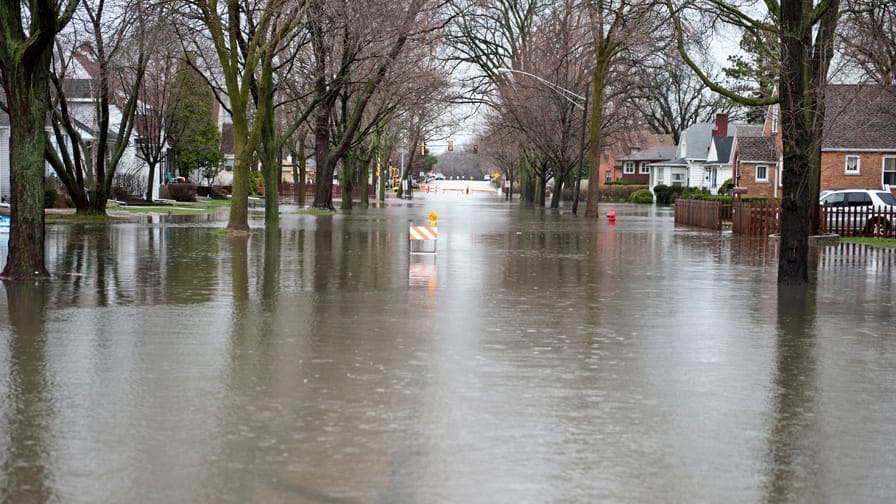
Standing water that doesn’t drain within 24 to 48 hours after rain isn’t an inconvenience. It’s a diagnostic.
A puddle that lingers is telling you the soil at that spot is saturated past its capacity to hold or move more water. That has consequences beyond a soft lawn:
- The water is still going somewhere. Most of it is infiltrating downward and laterally — and “laterally” often means toward the foundation, because the foundation footing creates a depression in the soil and water follows the path of least resistance. A puddle 20 feet from the house is still feeding the saturated soil ring around the foundation.
- The lawn dies and the soil compacts. Grass roots suffocate in saturated soil within 7 to 10 days. Once the grass dies, the bare soil compacts under rain impact and foot traffic, infiltration gets worse, and the puddle becomes more permanent each season. Foundation-adjacent shrubs and trees can fail the same way, and root death in larger plantings can destabilize the soil supporting nearby structures.
- It’s a mosquito and pathogen vector. Four days of standing water is enough for mosquito breeding. In NJ that matters from late May through October, and it’s a public health issue beyond your own property.
- It’s a foundation warning sign. A persistent low spot within 10 feet of the foundation isn’t just bad drainage — it’s often the visible part of a larger grading or settlement failure that’s actively directing water toward the wall.
The freeze-thaw amplifier. Standing water in March is a much bigger problem than the same puddle in July. Frozen subsoil prevents downward infiltration entirely, so spring rain has nowhere to go except sideways toward the foundation. Lots that drain acceptably in summer can flood the basement in March for exactly this reason.
The fix sequence — cheapest to most invasive.
- Identify the source. Is it roof discharge ending in the wrong spot? The natural low point of the lot? A yard drain whose outlet has failed? Groundwater rising through saturated clay? Different sources, different fixes — and treating the wrong one wastes money.
- Regrade the affected area. If the low spot is within 10 feet of the foundation, this isn’t optional. Bring in fill, re-establish the 5% pitch, reseed.
- Add a French drain or catch basin at the low point. When regrading isn’t possible because of existing landscape, hardscape, or unavoidable site contours, a collection-and-discharge system captures the water mechanically.
- Dry well or daylight discharge. Wherever the water goes, it has to actually leave the property — not just relocate to another spot on the same lawn.
- Call a drainage contractor. Persistent standing water near the foundation, water that returns every storm, or water that’s clearly tracking toward the house from an upslope source is past the point where a downspout extension and a bag of topsoil will solve it. That’s an assessment call.
Layer 4: Foundation Defense — When Water Reaches the Wall Anyway
Even good roof drainage and yard drainage can’t stop everything during a major NJ storm. When water reaches the foundation, the foundation itself becomes the next line of defense — and how well that defense holds depends on three things: the wall’s condition, the cove joint, and what’s happening under the slab.
How water gets through a foundation wall. Concrete and block foundations aren’t waterproof on their own. They’re water-resistant at best, and the resistance degrades over time. Water enters through:
- Cracks. Hairline cracks from settling, larger cracks from soil pressure, vertical cracks at form-tie locations. Even a hairline crack passes serious water under hydrostatic pressure.
- The cove joint. Where the foundation wall meets the footing is almost always the weakest point. Water that’s saturated the soil ring around the foundation finds the cove and pushes upward between the footing and the wall, then into the basement at floor level.
- Form-tie holes. In poured concrete walls, the metal ties used during pouring leave small holes that were supposed to be sealed at construction. Decades later, those seals often fail.
- Block walls’ hollow cores. In CMU foundations, water can enter at any compromised mortar joint and travel down through the hollow cores, exiting at the bottom course.
- Window wells. A clogged or undrained window well becomes a swimming pool against the basement window. Most basement windows are not built to hold back standing water.
The slab problem is separate. A “dry wall, wet slab” failure is more common than people realize, and it’s confusing because the walls look fine. The water is coming up through the floor — sometimes through visible cracks, sometimes through the joint where the slab meets the wall, sometimes through unsealed penetrations like the sump pit perimeter or the floor drain surround.
The cause is rising groundwater under the slab pushing upward. This is a hydrostatic pressure problem just like wall infiltration, but the response is different — wall fixes won’t address it. The sump pump in Layer 5 is the answer here.
Why this layer fails first in NJ. Three regional factors stack against foundations here:
- Clay soil holds water against the wall. Sandy soil drains; clay doesn’t. Once clay around the foundation saturates, it stays saturated for days, and the hydrostatic pressure stays high the entire time.
- Freeze-thaw cycles. NJ winters expand and contract foundation walls and the soil pressing against them. Hairline cracks widen each season. Ground that froze hard in January is the same ground that won’t accept any infiltration during a March thaw rain.
- Original construction era. A lot of NJ housing stock was built between the 1920s and 1970s, when foundation waterproofing meant a coat of tar on the exterior and not much else. Most of those original treatments are gone by now.
What foundation defense looks like. Honest scope matters here. Some of it is in our lane as a drainage contractor, and some of it isn’t:
- In our lane. Exterior grading and drainage to keep water away from the wall in the first place, downspout management, French drains along the foundation, footing drains tied into a sump system, and the sump pump system itself catching water that reaches the footing.
- Adjacent specialty work. Interior crack injection (epoxy or polyurethane), exterior membrane waterproofing during major excavation work, vapor barriers, and interior drainage channels around the basement perimeter. These are often handled by a waterproofing specialist, though we coordinate when foundation work intersects with the drainage system we’re installing.
The honest verdict for most NJ homes. If your foundation is more than 30 years old, the original waterproofing has effectively expired. The realistic defense plan isn’t “fix the foundation” — it’s “make sure the foundation never has to do the work alone.” Layers 1, 2, 3, and 5 carry most of the load. The foundation itself is what catches what those layers miss. When water is consistently reaching the wall in volume, the upstream layers aren’t holding, and that’s where the assessment starts.
Layer 5: Sump Pump — Catching the Water That Got Through
Some water will always reach the foundation footing during a major storm. The sump pump is the system designed to handle it.
A sump pit sits at the lowest point of the basement, often tied to a perimeter drain or footing drain that collects water before it can push through the wall or up through the slab. When the pit fills, the pump activates and discharges the water away from the house. Done right, a sump system can run continuously through a multi-day storm and keep the basement dry while every layer above it is being overwhelmed.
Why every NJ basement should have one. In central New Jersey, clay soil and rising water tables mean almost every below-grade space is sitting in soil that will saturate during a real storm. Even basements that have never flooded are usually one storm away from finding out their luck — and the cost of installing a sump pump preemptively is a fraction of the cost of remediation after the first failure. Full details on the installation process and what to expect are on our sump pump installation page.
Interior vs. exterior sump systems. Most residential sump pumps are interior — a pit and pump inside the basement, with a discharge line running out through the wall. Exterior sump systems are less common but useful for properties where the water collection problem is in the yard itself rather than at the foundation. The choice depends on where the water is and where it needs to go.
The capacity question. A sump pump rated for a typical residential application might move 30 to 50 gallons per minute. During an extreme storm, water can reach the pit faster than the pump can clear it, especially if the discharge line is restricted or the pump is undersized. Pump capacity, pit volume, and discharge line condition all need to match the actual water load — not the load the pump faced when it was installed twenty years ago.
Layer 6: Backup Power — Keeping the Last Line of Defense Online
A sump pump is only as reliable as its power source. And the storms that produce the most water are the same storms that knock the grid down.
Hurricane Ida, Hurricane Henri, and the major nor’easters of recent years all delivered the same combination across central New Jersey: hours of intense rainfall and widespread, multi-day power outages. Sump pumps lost power while groundwater was still rising. Basements that would have stayed dry with a working pump flooded within hours of the outage.
Battery backup vs. generator-backed power. Battery backup sump pumps are common and useful, but they have real limitations. Batteries weaken over time, often without obvious warning until the system is needed. Even a healthy battery typically runs at lower pumping capacity than the primary pump on utility power, which means it can fall behind during heavy groundwater intrusion. And battery runtime is finite — a long outage will eventually exhaust any battery.
A backup generator connection keeps the primary sump pump running at full capacity on dedicated power through the entire outage. The pump doesn’t switch to a smaller backup unit, doesn’t run at reduced output, and doesn’t time out after a few hours. As long as the generator has fuel, the sump system stays online. The details of how this connection is wired and integrated are on our sump pump backup generator connection page.
The sizing point. A generator that can’t carry the sump pump’s startup draw under load isn’t a solution — it’s a false sense of security. Sump pump motors pull more current at startup than they do while running, and an undersized generator will trip its overload protection at the worst possible moment. Backup power for a sump pump needs to be sized for the actual electrical demand, with margin for simultaneous loads like a furnace or refrigerator on the same circuit during the outage. That sizing isn’t a guess — it’s a documented load calculation that identifies every circuit the generator needs to support and matches the unit to the home’s real demand profile.
Layer 7: Backwater Valve — Blocking the Other Direction
Layers 1 through 6 all defend against water coming in from the yard, the roof, or the soil. They don’t defend against water coming up from the municipal sewer.
When a major storm overwhelms the municipal sewer system — common in older parts of New Jersey where combined sewer systems carry both stormwater and sanitary waste — the city’s main line fills past capacity. The pressure must go somewhere, and the somewhere is the path of least resistance. That path is usually the lowest open fixture connected to the municipal main, which is almost always a basement floor drain or basement toilet.
The result is sewage backing up through your basement fixtures during the same storm that’s already taxing every other defensive layer. It’s not a leak from outside the home — it’s the municipal system using your basement as a pressure relief valve.
What a backwater valve is. A sewer backwater valve is a one-way valve installed on the building’s main sewer lateral. Under normal conditions, the valve sits open and wastewater flows out of the home as usual. When flow reverses — when sewage starts pushing back up the lateral from the municipal main — a flap or gate inside the valve closes and seals the line. The home’s sewer fixtures stop draining temporarily (which is why backwater valves are paired with the “stop using water” guidance during a major storm), but the municipal sewer can’t push waste back into the home.
Where it sits in the system. Backwater valves are installed on the main sewer lateral inside the basement or just outside the foundation wall, before the lateral exits the property. Installation requires excavation or interior pipe work and is permitted under NJ plumbing code — it’s a licensed plumber job, not a DIY project. Some NJ municipalities and sewer authorities offer rebates for backwater valve installation in areas with a history of municipal backup events. Worth a call to your local public works department before you pay out of pocket.
What it doesn’t do. A backwater valve doesn’t prevent water from entering the basement through walls, the slab, or windows — those are problems for Layers 1 through 5. It only blocks municipal sewer backflow. It also closes the home’s drainage temporarily during peak events, which is why it’s part of a system rather than a standalone fix: if the backwater valve closes during a storm, you also need your sump pump (on backup power) to handle the groundwater that’s still arriving from outside the home.
The complete defense, finally assembled. A sump pump catches groundwater. A generator keeps the sump running when the grid drops. A backwater valve blocks the municipal sewer from pushing waste back into the basement. Three pieces, three different failure modes, none of them optional in a basement that’s worth protecting in central New Jersey. Any one of those three without the other two leaves a gap that the storms here will eventually find.
The Layered Defense in Practice
Most basements that flood in NJ aren’t missing one thing. They’re missing several layers, and a major storm overloads all of them at once.
The pattern we see in the field: gutters drop water at the wall, the yard has a low spot that’s been ignored for years, the foundation has hairline cracks that the original tar coating no longer covers, the sump pump is undersized for the actual water load, the battery backup hasn’t been tested since installation, and there’s no backwater valve on the lateral. None of those is catastrophic alone. Together, in a storm that lasts twelve hours and takes the grid down for two days, they produce a flooded basement.
A drainage contractor’s job is to walk the property and figure out which layers are present, which are working, and which are the weak link. Sometimes the fix is a single layer. More often it’s two or three coordinated changes that make the whole system work together — regrading and a French drain on the wet side of the lot, a properly sized sump pump tied to a generator circuit, a backwater valve on the lateral if the home is in a flood-prone municipality.
Frequently Asked Questions
Do I really need all seven layers?
No — but the more of them you have working, the more storm you can take before something fails. Most NJ homes need at minimum proper grading, a sump pump, and either battery backup or generator-backed power. Homes in areas with municipal sewer overflow history should add a backwater valve. The rest depends on the specifics of the lot.
What’s the order of operations if I’m doing this in stages?
Top down. Roof and yard drainage first — they’re cheapest and they reduce the load on every layer downstream. Sump pump and backup power next, because they’re what’s running during the actual storm. Backwater valve last, unless your home has already experienced sewer backup, in which case it moves up.
Will a sump pump work without good yard drainage?
Yes, but it will work harder than it should and fail sooner. A sump pump that’s running constantly because the yard is feeding water directly to the foundation is on borrowed time. Fix the upstream layers and the sump pump becomes a backstop rather than the primary defense.
Why does water come up through my basement floor even when the walls are dry?
Rising groundwater under the slab pushes upward through cracks, joints, and unsealed penetrations. The walls can be in perfect condition and you’ll still get water through the floor if the water table is high and there’s no sump system to relieve the pressure underneath.
What’s the difference between groundwater coming through the foundation and sewer water coming up through the floor drain?
Groundwater is generally clear and odorless. Sewer backup smells distinctly of sewage and may contain visible solids. If you have any doubt, treat all standing water as contaminated until you can confirm otherwise.
Our sewer backup guide covers what to do if it turns out to be the sewer.
Will a backwater valve stop my sump pump from working?
No — they’re on completely separate systems. The backwater valve sits on the sanitary sewer lateral. The sump pump discharges to a separate line running away from the foundation. The two systems don’t interact.
My basement has never flooded. Do I still need any of this?
A basement that hasn’t flooded yet is a basement that hasn’t yet seen the storm that overloads its defenses. In central NJ, that storm is a question of when, not if. The cheaper layers — roof drainage, grading, a sump pump on backup power — are worth installing preemptively. The more expensive layers are worth installing once you have a clear reason.
Schedule a Property Drainage Assessment
Before any work happens, the first step is a walk-through. A drainage assessment looks at your specific property — the roof drainage, the grading, where water pools, the foundation condition visible from outside, the existing sump system, and how the home’s lateral runs to the municipal main. The result is a layered defense plan that identifies what’s already working, what’s missing, and what the realistic priority order is for your lot and your budget.
No single fix protects every basement. The right fix depends on what’s failing first. Schedule a drainage assessment or call (908) 472-3801 and we’ll walk the property with you.