Most underground utility decisions in New Jersey come down to one of two questions. Either the pipe in the ground is the problem, or the path it’s running on is. The methods that fix each one are different — and which methods are even available depends on what you’re installing.
For sewer work, there are three method families. In-pipe trenchless methods — CIPP lining, pipe bursting, and epoxy coating — repair or replace the existing pipe along the route it already runs. Open-trench excavation replaces the pipe along a continuous open trench. Horizontal directional drilling installs new pipe along a brand-new path underground, without a continuous trench between the two ends.
For water work, the menu is narrower. In-pipe trenchless lining and bursting can’t be used for potable water — the materials aren’t rated for it. Water installations in New Jersey are open-trench or HDD only, with the approved pipe material set by which tier of the system is being worked on: ductile iron, PVC, or copper for the buried property-side service line running across the property; ductile iron only for the municipal water main in the public utility corridor. The installation method is the variable; the material is set by code and by where in the system the work is happening.
These aren’t competitors. They answer different questions. The framework we use across our sewer and water infrastructure guides — that the pipe and the soil around it are a system, and that failure can come from either side — extends naturally to installation decisions. If the pipe is the problem and the path is sound, the right answer is in-pipe trenchless (for sewer) or a targeted open-trench repair (for water). If the path is the problem, or if there’s no existing pipe at all and you’re installing fresh, HDD is often the only way to do the work without disturbing everything between the two ends.
This guide walks through where HDD fits in New Jersey underground utility work, where the other methods do the job better, and where neither HDD nor any trenchless approach is the right call.
Arrow Sewer & Drain provides horizontal directional drilling and broader excavating contractor services across New Jersey, with primary service in Middlesex, Somerset, Union, and Hunterdon counties.
In This Guide
- HDD, In-Pipe Trenchless, and Open-Trench: What Each One Does
- Both Methods Need Access Pits — That’s Not the Differentiator
- When the Path Is the Problem (Not Just the Pipe)
- Where HDD Fits for Sewer Work
- Where HDD Fits for Water Work
- What Determines Whether HDD Will Work on a Specific Site
- When HDD Won’t Work
- Concrete Coring & Foundation Penetrations: HDD’s Companion Technique
- HDD in New Jersey: Local Context That Matters
- Questions to Ask Any HDD or Drilling Contractor
- Frequently Asked Questions
- Where to Go From Here
HDD, In-Pipe Trenchless, and Open-Trench: What Each One Does
The three method families get lumped together in conversation, but they solve different problems through different mechanisms — and not all three are available for every application.
In-pipe trenchless works on the existing pipe along its existing path. CIPP lining inserts a resin-saturated liner inside the host pipe and cures it into a structurally independent pipe-within-a-pipe. Pipe bursting pulls a bursting head through the existing line, fracturing the old pipe outward while pulling a new HDPE pipe in behind it along the same path. Epoxy coating sprays a protective resin layer onto the cleaned interior wall of the host pipe. All three preserve the route; none of them changes where the line runs. In-pipe methods are available for sewer work and for some commercial and industrial waste applications. They are not available for any potable water installation — neither property-side service lines nor municipal water mains — because the resins, liners, and HDPE pipe used in those processes are not rated for drinking water.
Open-trench excavation is the traditional method: dig a continuous trench from one end of the line to the other, lay new pipe in proper bedding, backfill, and restore the surface. Open-trench works for any underground utility application — sewer, water, gas, drainage, conduit — using whatever material the code requires for that utility. Its limitation is surface disruption: the trench has to be dug across everything between the two endpoints, including driveways, hardscape, landscaping, and roadways.
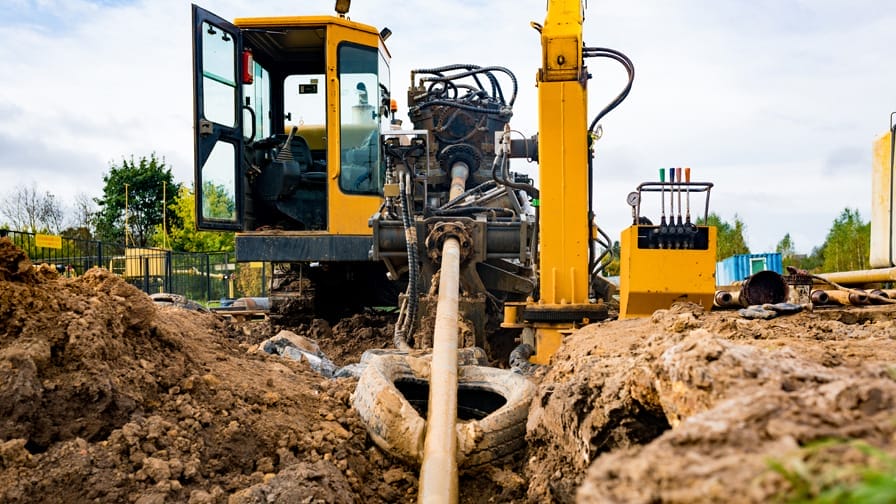
Horizontal directional drilling doesn’t touch any existing pipe and doesn’t require a continuous trench. A drill rig at one access pit launches a steerable bore underground, navigates it along a planned path to a second access pit at the destination, and then pulls the new utility line back through the bore. The new pipe is whatever material the application requires — ductile iron, PVC, copper, or HDPE — installed fresh along a route the property owner and contractor chose. The old pipe, if there is one, is decommissioned in place or removed at the access pits.
The practical difference: in-pipe trenchless fixes the pipe you have along the path it has. Open-trench replaces the pipe along a continuous excavation. HDD installs new pipe along a path of your choosing without a continuous excavation between the ends.
This three-way distinction matters because it determines what each method can’t do. In-pipe trenchless can’t move a line out from under a foundation, can’t change a route to avoid a known soil problem, can’t correct gradient on a sagging sewer line, and can’t be used at all for potable water. Open-trench can do all of those things but disturbs everything along the route. HDD can do most of those things and avoids the continuous trench, but can’t repair an existing pipe, can’t always handle rocky soil, and isn’t always the cheaper or faster option when the existing path is still good and unsurfaced.
The right choice depends on what’s being installed, whether there’s an existing pipe and what condition it’s in, and whether the existing path is still workable.
Both Methods Need Access Pits — That’s Not the Differentiator
One thing worth getting straight up front, because it’s the most common misconception about both trenchless and HDD work: neither one is “no-dig.”
In-pipe trenchless typically requires two access pits — one at the building’s cleanout or entry point, one near the property line or main connection. HDD also requires two: an entry pit where the drill rig launches the bore, and an exit pit where the bore terminates. Sometimes one or both pits double as the tie-in excavation, depending on the application.
What changes between the two methods isn’t whether you dig. It’s where you dig and what runs between the pits. In-pipe trenchless runs along the existing pipe’s path. HDD runs along a new bore path of your choosing. The pits at each end are roughly comparable in footprint. The ground between them is where the difference lives.
This matters for setting expectations on a project. A homeowner who hears “trenchless” or “directional drilling” and expects zero excavation is going to be surprised by the access pits regardless of which method gets chosen. The honest framing is that both methods replace a continuous trench across the property with two contained access excavations at each end. That’s a real reduction in surface disruption, but it isn’t no disruption.
When the Path Is the Problem (Not Just the Pipe)
Once you understand that the pipe and the path are separate variables, underground utility decisions sort into three categories — the same framework we use for sewer line failures applied to a different question.
The pipe is the problem; the path is fine. Aging cast iron with significant wall loss, Orangeburg breakdown, root intrusion at joints, internal corrosion, scale buildup, mechanical damage to a single section. The route the line runs on is still workable. The pipe itself is what’s failed. For sewer applications, this is the classic in-pipe trenchless scenario — fix the pipe, leave the path alone. For water applications, this typically means a targeted open-trench spot repair on the failed section, using approved potable materials.
The path is the problem; the pipe condition is secondary. This is the category most contractors don’t talk about, and it’s the category where HDD often becomes the right answer:
- The line runs under a foundation footing or load-bearing wall. Repair access is constrained, and any future repair will face the same constraint. A new path that avoids the structure entirely solves the problem permanently.
- The line runs under a finished surface that was added after the original install. Driveways, hardscape patios, parking lots, mature landscaping. The route is now expensive to access by open cut. A new path that avoids the finished surface can save the surface restoration cost entirely.
- The line runs through a tree root corridor that has destroyed it twice already. CIPP can seal the joints, but the tree isn’t going anywhere. A new path around the root zone is sometimes the only durable fix.
- The substrate along the existing path has failed. Pipe bursting installs new pipe through the same soil that caused the original failure; CIPP preserves whatever sag the original pipe developed. If the soil along the existing path is the actual failure mode, a new path through better-supported ground addresses the underlying problem instead of just the symptom.
- The application requires materials that in-pipe methods can’t deliver. This is the central reality for water work in New Jersey. The buried property-side service line — from the curb stop to the building entry — uses ductile iron, PVC, or copper depending on the project. The municipal water main in the public utility corridor uses ductile iron only. In both cases, the installation method is open-trench or HDD. If the route runs under a finished surface and open-trench would mean destroying it, HDD is the only way to do the work with code-compliant potable materials.
Both are the problem. Aging pipe along a failed path. This is more common than people realize — a 60-year-old sewer lateral with corroded cast iron sitting in clay-heavy soil that has shifted under decades of vibration loading often has both problems at once. The right repair depends on whether the path can be salvaged or whether starting fresh is more durable.
From Luis Fanlo, owner: In fifteen-plus years of underground work across New Jersey, the question I get asked most often is “can you do this without tearing up my driveway?” The honest answer is sometimes yes, sometimes no — and it depends on whether the pipe in the ground is the problem, or whether the path it’s running on is. HDD solves one of those problems, in-pipe trenchless solves the other, and neither solves both. A good contractor tells you which problem you have before they tell you which method they’d use.
Where HDD Fits for Sewer Work
For sewer work specifically, HDD’s value comes from changing the route rather than fixing what’s already there.
Sewer lateral installs under finished surfaces. A homeowner with a failing lateral that runs under a finished driveway or paver patio has two options when the existing pipe needs to be replaced: open-cut and restore the surface, or HDD a new lateral along a different route entirely. The original lateral gets capped at the building and abandoned in place; the new lateral runs from a new connection point through ground that hasn’t been surfaced. The driveway stays intact.
Re-routing around problem ground. Foundation crossings where access has always been constrained, tree root corridors that have repeatedly failed the line, easement boundaries that have changed since the original install. HDD lets the new line go around the problem instead of through it.
New connections to a different point on the municipal main. Property additions, splits, or significant expansions sometimes need a new sewer connection rather than a repair of the existing one. HDD installs the new lateral to a new tie-in point without disturbing the route the original lateral used.
Complement to pipe bursting, not a replacement for it. This is the honest point that should anchor any HDD-for-sewer conversation. Pipe bursting along the original path is often cheaper and faster when the path is sound. HDD is the right answer when the path isn’t. If the existing route is workable and the failure is in the pipe itself, pipe bursting through the original path is usually the better economic and durability call. HDD becomes the answer specifically when the original route is the constraint.
Honest limitation for sewer: sewer is gravity-fed. Gradient is non-negotiable. An HDD bore for a sewer lateral has to deliver consistent slope along its entire length — typically 1/4 inch per foot for residential — and bore geometry can fight that on longer runs or in mixed soil conditions. A good crew can hold gradient; not every site will permit it. On commercial main sewer line work with engineered slope tolerances, this becomes a feasibility question that has to be answered before the bore plan is finalized.
For replacement of Orangeburg sewer laterals — extremely common across post-war NJ housing stock — the choice between pipe bursting and HDD usually comes down to surface conditions along the original route. Original route still clear and unsurfaced: pipe bursting is typically the right call. Original route now runs under driveway, hardscape, or mature landscaping: HDD becomes worth pricing.
Where HDD Fits for Water Work
For water work, HDD fills a gap that no other trenchless method can fill in New Jersey.
The water line repair-or-replace guide is direct about this: trenchless lining and pipe bursting can’t be used for potable water. The materials used in those processes aren’t rated for drinking water. Water work in NJ uses approved potable materials only — and the approved material depends on which tier of the system is being installed.
Inside the building, interior distribution piping from the meter to the fixtures is typically copper. This is plumbing work, not underground utility work, and HDD doesn’t apply to it.
Outside the building, on the property side, the buried property-side service line running from the curb stop to the building entry uses ductile iron, PVC, or copper depending on the project and applicable code. This is the tier most homeowners are thinking about when they say “water service line.”
In the municipal utility corridor, the water main running under the public street uses ductile iron only. This is utility-owned infrastructure beneath the road, sized to serve many properties.
HDD is an installation method for the buried tiers — the property-side service line and the municipal main. The pipe materials don’t change based on the installation method; the same ductile iron, PVC, or copper a property-side service line installation would use by open-trench is what HDD installs on the property side, and the same ductile iron a municipal main replacement would use by open-trench is what HDD installs under the street.
Applications where HDD makes sense for water:
- Property-side service lines under finished driveways or hardscape. The most common application. Homeowner has a failing copper or galvanized service line running under a driveway that was finished after the original install. Open-cut means destroying and rebuilding the driveway. HDD installs the new property-side service line — ductile iron, PVC, or copper depending on the project — along a bore path that crosses under the driveway in a controlled penetration, with access pits at the curb stop and building entry.
- Commercial property-side service lines under parking lots and access drives. Same logic at larger scale and longer runs. The buried property-side service line uses ductile iron, PVC, or copper depending on the project; HDD installs it under the finished surface without resurfacing. The cost of resurfacing a commercial parking lot is often higher than the marginal cost of the bore.
- Municipal water mains crossing under roadways. Ductile iron mains run beneath the public street in the utility corridor, and replacement or new installation by open-cut means closing lanes, managing traffic, and restoring pavement — work that can extend the project by weeks on a county arterial or state highway. A bore under the roadway installs the ductile iron main while traffic continues overhead, with access pits located in the shoulder, intersection, or other workable ground at each end of the crossing.
- Replacement service lines under New Jersey’s Lead Service Line Replacement mandate. NJ’s statewide LSL inventory and replacement law means a substantial number of properties will be replacing property-side service lines over the next several years. On properties with finished surfaces between the curb stop and the building, HDD is often the lowest-disruption way to do that replacement using code-compliant materials.
Honest limitation for water: HDD doesn’t change any of the other code requirements for water work. The access pits at each end still need to provide the working room for tie-in, pressure testing, disinfection, and inspection — all of which apply to HDD-installed water lines identically to open-trench-installed lines. The bore method changes the access footprint, not the material approval, the pressure testing sequence, or the inspection workflow.
For commercial properties with private mains feeding multiple buildings or large process loads, the HDD-vs-open-trench question often comes down to surface conditions along the route and the cost of downtime for the property’s operations. A site assessment is the only way to answer it honestly. For broader context on how that decision shapes up for commercial water main work, the same repair-or-replace framework applies.
What Determines Whether HDD Will Work on a Specific Site
An HDD project starts with a site assessment, not a quote. The bore plan depends on what’s in the ground along the proposed path, and that has to be confirmed before the work scope can be priced honestly. Four factors do most of the work in determining feasibility.
Soil conditions along the bore path. Clay-heavy New Jersey soils are workable but slow the drilling and require careful fluid management. Sandy and gravelly soils drill faster but can pose bore stability concerns that need active management during the work. Mixed soil profiles — common across central NJ where deposits change within short distances — require the bore plan to account for transitions between soil types. Rock is the most significant variable. Bedrock outcroppings appear in parts of Hunterdon and western Somerset counties and can stop a standard HDD bore or require upgraded rock-capable equipment, which changes the project cost.
Groundwater. High water tables in flood plains, along the Raritan River corridor, and in low-elevation neighborhoods affect bore fluid behavior and the conditions in the access pits. Workable, but a factor in the bore plan and access pit shoring. Groundwater that’s high enough to fill the access pits during the work creates additional management requirements that extend the project timeline.
Existing utility congestion. NJ One Call (811) mark-outs identify what’s already in the ground, but the bore path has to clear all identified utilities with adequate separation per NJDOT and utility standards. Dense urban corridors with stacked utilities — gas, water, sewer, electrical, communications, drainage — sometimes can’t accommodate an HDD bore at any reasonable depth. In those cases, hydro excavation is often used to daylight existing utilities and confirm clearance before the bore is committed to.
Surface loading and depth requirements. Bores under roads and driveways need to be deep enough that surface loading from vehicles doesn’t compromise the new line over time. NJ frost depth — typically 36 to 42 inches depending on jurisdiction — sets a minimum for water and sewer service lines. Bores under heavily loaded surfaces often run deeper than frost minimum for additional load protection, particularly under commercial parking lots, county arterials, and any crossing of a state highway.
The site assessment is what turns these four variables into a buildable bore plan. A contractor who quotes HDD work without first walking the proposed route, reviewing utility mark-outs, and evaluating soil conditions is quoting a guess. The plan has to come first.
When HDD Won’t Work
HDD is a powerful method for the right application, but it isn’t universal. Several situations where any honest contractor should recommend a different approach instead.
Severe rock along the bore path. Standard HDD rigs aren’t rock rigs. If a site assessment identifies bedrock or significant rock along the proposed route, the project either upgrades to rock-capable equipment — which changes the cost meaningfully — or shifts to open-cut excavation. Parts of New Jersey have shallow rock that disqualifies HDD without specialized equipment.
Ultra-short runs. HDD has fixed setup overhead — rig positioning, fluid system setup, access pit excavation. For very short crossings — a single short driveway, a sidewalk crossing, a short walkway — the bore setup time often exceeds what an open-cut would take from start to finish. The combined footprint of the two access pits can also exceed what an open trench would disturb on a short run. In those cases, open-cut is faster, cheaper, and produces less total disturbance.
Slope-critical sewer applications where bore geometry can’t deliver consistent gradient. As covered in the sewer applications section: gravity-fed lines need precise slope, and bore geometry has limits. On longer sewer runs in mixed soil, holding consistent 1/4-inch-per-foot fall across the entire bore can be technically challenging. A good crew can do it; not every site will permit it. Where the slope tolerance is critical and the bore conditions are uncertain, open-cut with conventional pipe-laying gives more direct control over gradient.
Lines that must follow an existing easement. Some property line easements only permit the original route. If the easement won’t permit a new path, HDD’s “new path” advantage disappears and the work has to follow the original route — typically with in-pipe trenchless or open-cut along the easement line.
Sites where the destination point can’t be located precisely. HDD requires a target. The bore is steered toward a known exit point at the receiving access pit. If the destination — a foundation entry point, a tie-in to an existing line, a curb stop location — can’t be located precisely before the bore starts, the work can’t terminate cleanly. Surface obstacles that prevent surveying the exit point have to be resolved before the bore begins.
When in-pipe trenchless will do the job better. For sewer applications where the existing pipe is failing along a route that’s still good, in-pipe trenchless — CIPP, pipe bursting, or epoxy coating depending on the pipe condition — is usually the right call, not HDD. HDD’s job is the new path. If a new path isn’t needed, there’s no reason to bore one.
A contractor who recommends HDD for every underground utility job is selling a method, not solving a problem. The right answer references the site, the existing route, the failure mode if there is one, what the destination point actually requires, and what methods are even available for the utility being installed.
Concrete Coring & Foundation Penetrations: HDD’s Companion Technique
HDD bores under or alongside a building still need a clean penetration into the building itself. That’s where concrete coring comes in, and it’s why coring and HDD often appear together as part of the same drilling contractor services.
Concrete coring creates code-compliant openings through foundation walls and slabs for water and sewer service entry. The opening is sized to fit the service pipe plus the appropriate sleeve and seal, cut with diamond-tipped coring equipment that produces a clean, controlled penetration without cracking the surrounding concrete. For HDD work, the building entry coring is typically scheduled to align with the bore termination — the bore exits at a known point outside the foundation, and the cored opening provides the controlled entry into the building.
Concrete drilling is a related but distinct service — smaller-diameter drilling used for anchors, conduit supports, or controlled infrastructure penetrations rather than the larger pipe entries that coring produces. Different application, different equipment, same broader category.
New Jersey basement entry conditions vary by construction era. Pre-1960 foundations are often poured concrete or block of varying thickness with limited tolerance for vibration during coring. Newer foundations are typically poured concrete to consistent specifications with documented thickness. The coring approach depends on what the foundation actually is, which is part of the pre-work assessment.
HDD in New Jersey: Local Context That Matters
Several New Jersey-specific factors affect HDD project planning, permitting, and execution. Worth understanding before any project starts.
NJ One Call (811) mark-outs are required by law before any underground work, including HDD bores. The mark-out identifies what’s in the ground along the proposed bore path and is the starting point for confirming the route is clear. Underground utility damage during a bore is one of the most costly mistakes possible on an HDD project, and mark-outs are the first defense.
Municipal permitting typically includes a plumbing permit for any sewer or water work, a road-opening permit if the bore crosses or terminates in a public right-of-way, and separate connection permits for tie-ins to municipal sewer or water mains. Permit fees and inspection requirements vary by municipality. A licensed contractor handles permit applications and inspection coordination as part of the project.
NJDEP requirements for potable water installations govern material specifications, pressure testing, disinfection, and inspection sequence for any water work. These requirements apply identically to HDD-installed and open-trench-installed water lines — the bore method doesn’t change what the line has to do or how it has to be tested.
Coordination with municipal water authorities is typically required for any tie-ins to municipal water mains, curb stop work, or meter relocations. The authority will inspect the work at defined stages and coordinate any temporary service interruptions for affected properties.
County and township variation. Middlesex, Somerset, Union, and Hunterdon counties all have municipalities with their own inspection workflows, permit timelines, and contractor approval requirements. A project that runs smoothly in one township may face different inspection scheduling in the next one over. A contractor familiar with local workflows can compress permit and inspection timelines significantly compared to one learning a new municipality mid-project.
Traffic management for road crossings becomes a major project variable when HDD bores cross county arterials or state highways. NJDOT involvement on Route 22, Route 1, Route 27, Route 9, and other state routes adds permit and traffic management requirements that extend the project timeline. Bores under heavily trafficked roads are still typically faster than open-cut on the same crossing — the open-cut would require lane closures during excavation, restoration, and inspection — but the project complexity scales with the road’s classification.
Questions to Ask Any HDD or Drilling Contractor
A drilling project is only as good as the contractor who installs it. Before you sign a contract, ask:
- Are you licensed, bonded, and insured for underground utility installation in New Jersey? HDD work without proper licensing is a red flag.
- Have you done a site assessment? What did the soil conditions, groundwater, and existing utilities tell you about feasibility? A quote without a site assessment is a guess.
- Will you pull NJ One Call mark-outs before the work, and provide post-bore as-built drawings showing the new line’s actual path? Both should be standard, not upcharges.
- What approved materials will you install? For property-side water service work (curb stop to building), confirm ductile iron, PVC, or copper per NJ code. For municipal water main work in the public utility corridor, confirm ductile iron — it’s the only approved material for water mains in NJ. For sewer, confirm code-compliant materials for the application.
- What’s the planned bore depth, and how does it relate to NJ frost depth and surface loading along the route? A good answer references the specific conditions of the site, not generalities.
- What’s the manufacturer’s warranty on the pipe being installed? This is the actual durability guarantee — not contractor claims.
- Are permits being pulled, and by whom? A licensed contractor handles plumbing permits, road-opening permits, and inspection coordination as part of the project.
- What happens if the bore encounters rock, groundwater problems, or unexpected utility conflicts mid-job? Get the contingency plan in writing alongside the base scope.
- Why HDD and not in-pipe trenchless or open-trench for this specific application? A good answer references the route, the existing pipe condition if any, the material requirements, and the specific reason a new path is needed.
- Is the failure pipe-driven, substrate-driven, or both — and is HDD the right answer to whichever it is? If the contractor can’t or won’t make this distinction, that’s a sign they may be selling a method rather than solving your actual problem.
If you’ve already received a quote and something feels off — particularly if no site assessment was performed or no specific findings were referenced — a free second opinion costs you nothing and frequently changes the recommendation.
Frequently Asked Questions
What’s the difference between HDD and pipe bursting?
Pipe bursting replaces an existing pipe along the same path the original pipe runs. A bursting head fractures the old pipe outward while pulling a new HDPE pipe in behind it. HDD installs a brand-new pipe along a brand-new path. The original pipe is either abandoned in place or removed at the access pits, and the new line goes somewhere the old one didn’t. Pipe bursting is usually the right answer when the existing route is still workable. HDD is the right answer when the route itself is the problem. Pipe bursting is also limited to sewer and similar non-potable applications — it can’t be used for water service lines or municipal water mains because the HDPE pipe isn’t rated for potable water.
Can HDD be used for water service line replacement in NJ?
Yes. In fact, HDD is one of only two installation methods available for buried water work in NJ — the other is open-trench excavation. Both install approved potable materials, with the material set by where in the system the work is happening: the buried property-side service line (curb stop to building) uses ductile iron, PVC, or copper; the municipal water main under the public street uses ductile iron only. In-pipe trenchless lining and pipe bursting can’t be used for any potable water installation because the materials aren’t rated for drinking water. Interior distribution piping inside the building is separate work (typically copper) and isn’t an HDD application. HDD’s role for water work is reducing surface disruption when the buried route runs under finished surfaces; the pipe itself is identical to what an open-trench job would install.
Does HDD require any digging at all?
Yes. HDD requires two access pits — one entry pit where the drill rig launches the bore, and one exit pit where the bore terminates. Sometimes one or both pits double as the tie-in excavation. The pits are roughly comparable in footprint to what in-pipe trenchless methods require at each end. What HDD eliminates is the continuous trench across the property between the two access points — not the pits themselves.
How deep does an HDD bore typically go in NJ?
Bore depth depends on the application, the surface conditions along the route, and code requirements for the utility being installed. New Jersey frost depth — 36 to 42 inches depending on jurisdiction — sets a minimum for water and sewer service lines. Bores under driveways, parking lots, and roadways often run deeper than frost minimum to provide additional protection against surface loading. The bore plan specifies depth for each segment of the route based on what’s above and what’s required for the utility.
Will HDD work under a finished driveway?
Generally, yes — driveway crossings are one of HDD’s most common applications. The bore passes under the driveway in a controlled penetration, with access pits located in unsurfaced ground at each end. The driveway itself stays intact. Crossings of driveways, hardscape patios, walkways, and parking lots are among the most common reasons HDD gets chosen over open cut.
Can HDD fix gradient problems on a failing sewer line?
Carefully, and only on a new path. An HDD bore for a sewer lateral can deliver new gradient on a new path — that’s its core capability. But bore geometry has limits, and holding consistent slope on longer runs in mixed soil can be technically challenging. On commercial main sewer lines with engineered slope tolerances, gradient feasibility has to be confirmed in the bore plan before the work is committed to. HDD doesn’t gradient on an existing pipe — for that, the existing line must be replaced along a new path with correct slope.
Does HDD work in rocky soil?
Depends on the equipment and the severity of the rock. Standard HDD rigs aren’t rock rigs and can be stopped or damaged by significant bedrock or rock formations. Rock-capable HDD equipment exists and can handle the conditions, but the cost is meaningfully higher. Parts of Hunterdon and western Somerset counties have shallow rock that disqualifies standard HDD without specialized equipment. A site assessment identifies whether rock will be a factor before any bore plan is finalized.
What permits are required for HDD work in NJ?
Plumbing permits for sewer and water work, road-opening permits if the bore crosses public right-of-way, and separate connection permits for tie-ins to municipal mains. NJ One Call (811) utility mark-outs are required by law before any digging or boring begins. Permit fees and inspection requirements vary by municipality. A licensed contractor handles permit applications and inspection coordination as part of the project.
Is HDD more expensive than open-trench installation?
The bore line item is sometimes higher than basic open-trench excavation, but the all-in cost frequently comes in lower on properties with finished surfaces. Once you factor in landscaping restoration, hardscape and driveway repair, parking lot resurfacing, sidewalk and curb cuts, and the time cost of the longer project, HDD often comes in at or below the all-in cost of open cut. The savings are largest on properties where the route runs under significant finished surface. For short runs over unfinished ground, open-cut is typically the cheaper and faster option.
When should I get a second opinion on an HDD or open-trench quote?
If the contractor didn’t perform a site assessment, didn’t reference specific findings from soil conditions or utility mark-outs, didn’t explain why their recommended method is the right one for your specific situation, or recommended a method without considering the alternatives available for that specific application — those are all signs to get a second opinion. It costs you nothing and frequently changes the recommendation.
Where to Go From Here
If you have an underground utility project that might benefit from horizontal directional drilling — or you’ve received a quote and want to confirm it matches the actual conditions on your site — the next step is a site assessment, not a repair commitment.
- Drilling Contractor services — full scope of HDD, concrete coring, and underground utility access work
- Sewer Scope Inspection — diagnostic for residential sewer condition before any installation or repair decision
- CCTV Sewer Inspection — diagnostic for commercial and larger-diameter sewer systems
Contact us today
Call (908) 595-1597 or request an estimate for horizontal directional drilling and underground utility installation across central New Jersey.