Most of our guides dig into how a sewer problem gets diagnosed and repaired. This one steps back to the questions homeowners ask before any of that — what’s actually under your property, who’s responsible for it, when a problem is an emergency, and how New Jersey’s weather and infrastructure factor in.
Elsewhere on our blog we cover the technical side in depth: why sewer lines fail, what a camera inspection actually shows, root intrusion in NJ lines, which trenchless method fits which problem, and how to maintain a sewer line. The questions below are the ones that come before the repair conversation — the basics of owning a sewer system in New Jersey. As always, the honest answer to most of them ends the same way: the only way to know for certain what’s happening underground is to put a camera in the line.
Knowing What You Have
Do I have a sewer system or a septic system — and how can I tell?
It’s a more common question than you’d think, especially for people who just bought a home. The quickest tells: if you receive a monthly or quarterly sewer charge from your town or a utility, you’re almost certainly on a municipal sewer. If you have no sewer bill and there’s a tank lid or a grassy mound somewhere in the yard, you likely have a septic system with a leach field. Your property records or the local health department can confirm it.
Across New Jersey, denser towns and older neighborhoods are typically on municipal sewer, while more rural and outlying lots often run on septic. It matters because the two systems fail differently and need different care — a septic system has a tank and drainage field to maintain, while a sewer lateral connects to a public main. Arrow services both, so if you’re not sure what you have, that’s a fine place to start the conversation.
What’s the difference between my sewer lateral and the city main?
Your sewer lateral is the privately owned pipe that carries wastewater from your house out to the connection at the public sewer main — usually buried under your yard and out toward the street. The municipal main is the larger public pipe, typically running under the road, that the town maintains. The distinction is the whole basis for the responsibility question below, and it shapes who you call when something goes wrong. We explain how residential laterals and municipal mains fail differently in our guide to why sewer lines fail.
What is a sewer cleanout, where is mine, and why does it matter?
A cleanout is a capped access point on your sewer lateral — usually a short vertical pipe with a screw cap, found near the foundation, in the basement or crawlspace, or in the yard between the house and the street. It exists so a technician can run a camera or a cleaning tool straight into the line without pulling a toilet or opening up a wall.
Knowing where yours is (or whether you have one at all) makes every future service faster, cleaner, and less invasive. Homes without an accessible cleanout can still be inspected, but access is harder. When we run a sewer scope inspection, the cleanout is typically where the camera goes in.
Isn’t my sewer line the same as my water line?
No — and mixing them up causes real confusion. Your sewer line carries waste away from the house. Your water service line brings clean drinking water in. They’re separate pipes governed by different rules: because a water service carries potable water, codes require different pipe materials and the repair options aren’t identical to sewer work. If your issue is on the incoming water side, that’s a different job — see water line or water main repair-or-replace guide. This guide is about the sewer side.
Responsibility and the Town
Who is responsible for the sewer line — me or my municipality?
This surprises a lot of homeowners: in most New Jersey municipalities, you own the entire sewer lateral from your house all the way to the connection at the public main — including the portion running under the sidewalk and street. The town generally maintains only the main itself. So if the failure is anywhere along your lateral, it’s typically your responsibility to repair.
Rules vary town to town, so it’s always worth confirming with your local utility or public works department. And if the problem turns out to be at or past the city’s connection, that’s the municipality’s responsibility — which is exactly why a camera inspection with locating data matters. It pinpoints where the issue sits, and that evidence can settle the responsibility question.
Do I have to deal with the town and permits myself?
No. Sewer lateral work in New Jersey almost always requires a plumbing permit — and often a separate road-opening permit when the work affects the sidewalk or street — but a licensed contractor handles that for you. We pull the required permits and coordinate municipal inspections as part of the job, so you’re not navigating paperwork on your own.
Be cautious of anyone who offers to skip permits to save time; unpermitted sewer work can become a problem when you sell the home. Arrow works under NJ Master Plumber License #36BI01352100. If you want the detail on permitting around a specific repair method, our trenchless method guide walks through it.
Safety and Urgency
Is a sewage smell inside my house dangerous?
A faint, occasional sewer odor is often something minor — a floor drain or seldom-used fixture whose trap has dried out and stopped blocking gas, or a venting issue. But a persistent or strong sewage smell shouldn’t be ignored. Sewer gas is a mix that includes hydrogen sulfide and methane; at low levels it’s mostly an unpleasant nuisance, but stronger or prolonged exposure can cause headaches and nausea, and methane is flammable.
If the smell is strong, ventilate the area and get the source identified rather than masking it. We break down the usual culprits in our guide to where a sewer or drain smell is coming from. A recurring indoor sewer odor can also point to a crack or break in the line, which is one of the warning signs of a failing sewer line worth having checked.
Is a sewer backup a health hazard? Do I need to leave the house?
Raw sewage carries bacteria and pathogens, so a backup is a genuine health concern — not just a mess. Keep children and pets away from the affected area, avoid skin contact, stop using the plumbing that drains into the backed-up line, and ventilate the space. You usually don’t need to leave the home for a contained backup in a basement or single fixture, but you should avoid the affected area until it’s cleaned and disinfected. For the step-by-step on what to do in the moment, see our guide on what to do right now during a sewer backup.
One drain is slow — is that a clog or a sewer line problem?
Location and pattern tell you a lot. A single slow or clogged fixture — one sink, one tub — is usually a localized clog in that fixture’s branch line. When several fixtures slow down together, when the lowest drains in the house (a basement floor drain or first-floor toilet) back up, or when you hear gurgling as water runs elsewhere, the problem is more likely in the main sewer line.
Recurring clogs that keep coming back after cleaning are another tell that something structural is going on rather than simple buildup. Tree roots are a frequent culprit in New Jersey — we cover how to distinguish root intrusion from an ordinary clog, and when symptoms point to the main line, a camera inspection confirms what’s happening.
New Jersey Weather and Backups
Can heavy rain or storms cause my sewer to back up?
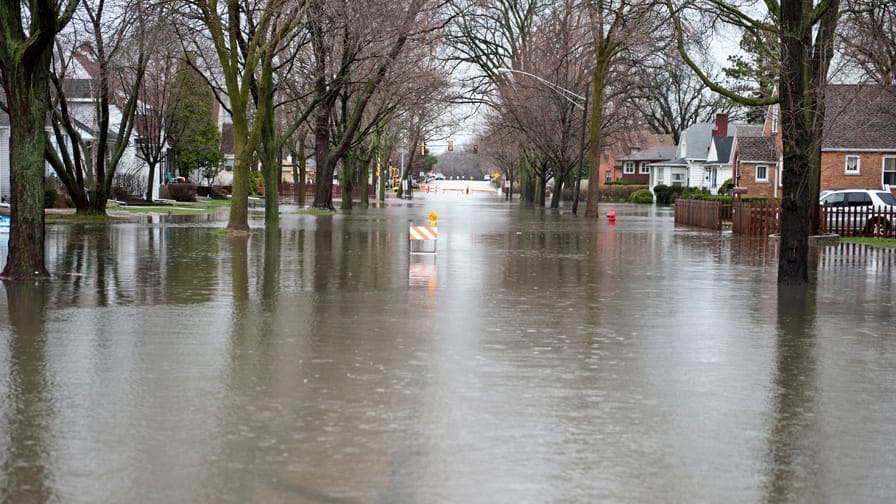
Yes. During heavy New Jersey storms, municipal systems can become overwhelmed or surcharged, pushing water back toward homes connected to the main. Groundwater also infiltrates aging lines through cracks and separated joints, adding load exactly when the system is already stressed. If your backups seem to coincide with big rain events, that’s a meaningful clue about what’s going on. Our guide to why sewer lines fail explains how water and saturated soil work against buried infrastructure here.
Would a backwater valve help protect my home?
For many homes, yes. A backwater valve installs in the sewer line and automatically closes when flow tries to reverse — stopping sewage from a surcharged municipal main from backing up into your home during storms or flooding. It’s especially worth considering if you have plumbing fixtures in a finished basement or a history of weather-related backups. We cover candidacy and installation on our sewer backwater valve installation page.
Should I get a sewer inspection before buying a home in New Jersey?
We strongly recommend it, particularly for homes built before the early 1970s, which often still run on the original clay, cast-iron, or Orangeburg lateral. A standard home inspection does not include a look inside the buried sewer line — so the condition of one of the most important underground components stays completely invisible unless you specifically scope it. A pre-purchase sewer scope shows you exactly what you’re buying and gives you real information before closing. For what a proper inspection should include, see what cameras show.
Have a Sewer Question We Didn’t Cover?
Every property is different, and the most reliable answer always comes from seeing the line itself. If you’re dealing with a backup, an odor, a slow drain, or you just want to understand the system under your home, Arrow Sewer & Drain can inspect your line, explain exactly what we find, and recommend the right next step — no pressure.
We also offer a free second opinion on existing sewer quotes. Contact us or call (908) 595-1597.